
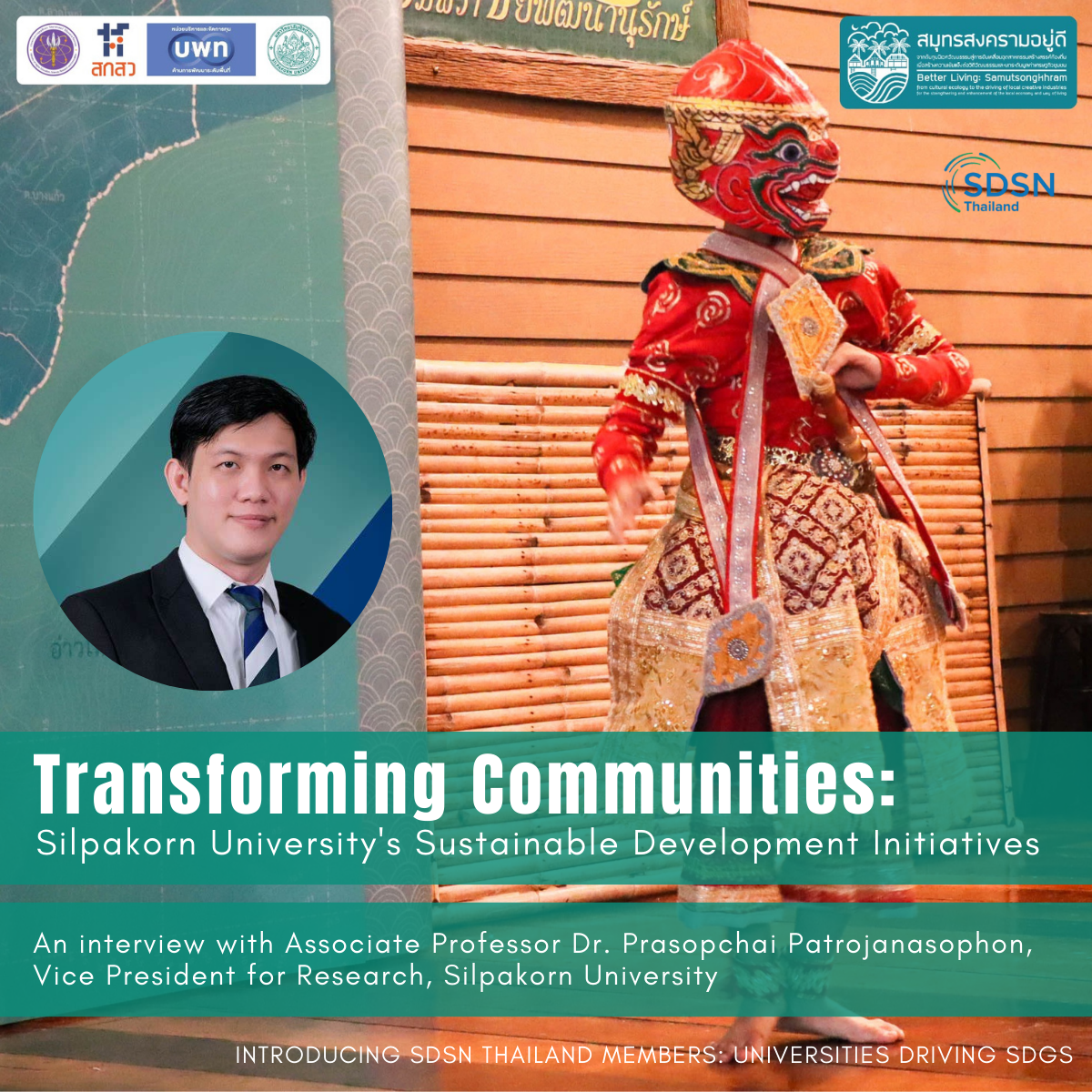
Transforming Communities: Silpakorn University’s Sustainable Development Initiatives
Silpakorn University, a key member of the Sustainable Development Solutions Network (SDSN) Thailand, is making significant strides in fostering sustainable development. In this interview, we delve into the university’s transformative initiatives with Associate Professor Dr. Prasopchai Patrojanasophon, Vice President for Research, who sheds light on the university’s commitment to driving the Sustainable Development Goals (SDGs) forward. From integrating sustainability into curricula and empowering local communities through projects like “Better-Living Samut Songkhram,” to addressing challenges and outlining future initiatives, Dr. Prasopchai provides valuable insights into the university’s active role in creating a meaningful impact on society.
1.What have been some of the key contributions of SU in promoting sustainable development education from last year? And the role that SU plays to drive SDGs forward and create a meaningful impact on society; how active is it? While participating in a network of academic institutions focused on sustainable development?
Silpakorn University has recently begun to promote sustainability under the current rector, Professor Dr. Tanasait Ngawhirunpat, President of the university. Previously, there were initiatives in place, but they lacked a cohesive approach or well-defined policies. Currently, the university is enhancing education by integrating sustainable development knowledge into various courses for students. There has been an increase in sustainability-related courses, including online classes available for external participants.
In line with the rector’s vision, Silpakorn University focuses on promoting well-being within society. The university has initiated various projects aimed at enhancing community welfare. Notable projects include the “Better-Living Samut Songkhram” initiative, where faculty and researchers engage with local areas to elevate the local economy by creating new entrepreneurs and job opportunities. This initiative also aims to enhance existing community products, adding value and generating income while promoting local arts and culture, such as children’s traditional performances, which help preserve local cultural heritage and instill pride among youth.
Beyond Samut Songkhram, Silpakorn University has extended its efforts to Phetchaburi province by working at the policy level to elevate the region’s food recognition from UNESCO. The university travels throughout Phetchaburi to promote local enterprises and develop products that can increase income.
The two main projects mentioned involve collaboration with community leaders to ensure their participation, enabling significant progress in sustainable development efforts.
Additionally, Silpakorn University manages sustainability initiatives on campus, implementing policies for water management, waste management, and resource management. For instance, the Phetchaburi campus received a gold medal for its green office project. The university collaborates across various sectors and provides research funding aligned with sustainability goals to drive initiatives forward. Overall, there has been considerable growth in these efforts compared to previous years.
2. What are some of challenges?
The first challenge is related to the people within the organization. Initially, Silpakorn University began to push for sustainability not long ago, and the university community might not fully understand what we are doing or what we are focusing on. This lack of understanding significantly impacts the organization’s ability to drive sustainability initiatives and implement projects that can create social and community impacts. We need various sectors, including different faculties, to be aware of and aligned with our goals. In the past, we focused on building knowledge within the university and also extending that knowledge externally, but perhaps we haven’t employed a very proactive strategy. However, having a mutual understanding of these driving efforts will enhance the success of our initiatives.
Some aspects of driving sustainability require changes to physical infrastructure, which involves investment and can make certain initiatives challenging to implement. Nevertheless, some projects can be pushed forward effectively.
Community feedback has been positive, especially regarding projects we have implemented ourselves. The community wants us to continue expanding these projects, and we are striving to ensure continuity. Continuity is essential because when we start a project, the wellbeing of local people improve, but once we leave, they often cannot sustain that progress. Therefore, we are now focusing on transferring knowledge to the community so that they can continue independently even after we withdraw from the area. We aim to act as advisors rather than take over their tasks, allowing them to learn and maintain ongoing operations themselves.
3. In 2025, how will Silpakorn University advance sustainable development, and what initiatives will it implement to promote SDGs?
This year, we are driving important initiatives in education, research, and community engagement. In education, we are increasingly pushing for changes at the curriculum level and having more discussions within the university.
We will promote various projects that we already implement in teaching and learning, which focus on internal learning. However, this time, we want to extend our teaching efforts outward. If there are challenges arising in the community, we will bring those issues back to plan projects that can be integrated into the curriculum to create connections. We are also communicating this policy to different faculties so that faculty members and students can take the lead in these initiatives. We are stimulating discussions around sustainability in education through this work.
Regarding research, we continue to promote and push forward as we did last year, but this year we are focusing on conducting research that addresses community needs. We have increased research funding and budgets to support sustainability efforts. We have both internal funding and external grants, which are aligned with sustainability policies.
In terms of governance, we have discussions with senior management teams to push forward important issues such as budgeting. We are allocating more budget to drive sustainability initiatives. There will be significant changes in energy usage within the university this year, including a major shift towards reducing energy consumption by implementing solar rooftop energy instead of relying solely on electricity. We will also maintain various policies related to waste management from upstream to downstream, water management, energy systems management, and conservation efforts.
For community engagement, we communicate with faculties to ensure they undertake projects that give back to society or address social challenges. This is part of the rector’s policy and goal: to create measurable change in the community effectively.
4. What is your personal reflection when it comes to sustainability? How will our country transform by adapting SDGs in all segments of our life?
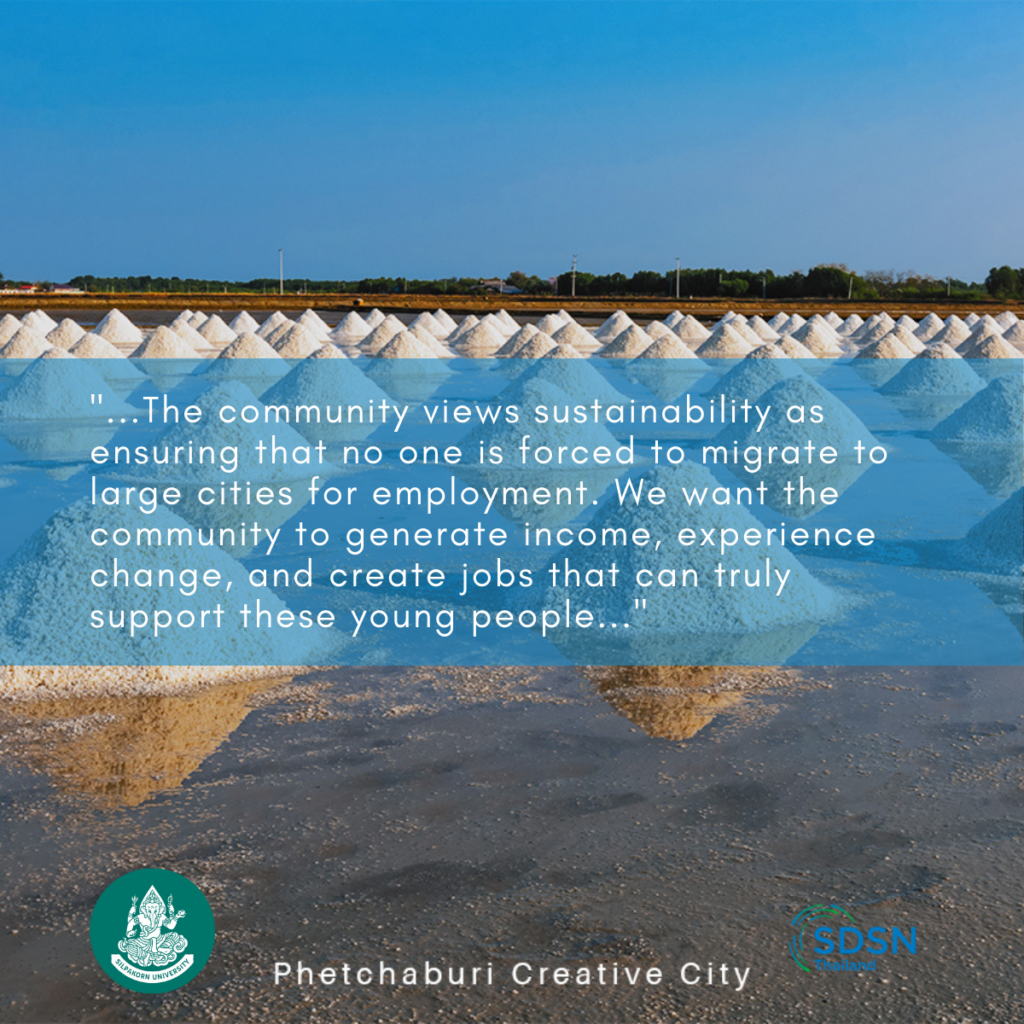
For Thailand, I believe that if we can continue to implement, promote, and make these initiatives a reality, the local communities will benefit significantly. The people will live better and have improved livelihoods because, as a university, we aim to promote community economies and grassroots economies. If we can sustain these efforts, we will be creating new job opportunities for the community. Young people will be able to stay in their communities longer because they can grow up without needing to move to cities for work; instead, they can work within and for their communities. The community views sustainability as ensuring that no one is forced to migrate to large cities for employment. We want the community to generate income, experience change, and create jobs that can truly support these young people.
Young people want to return and generate income for their communities rather than seek income elsewhere. Being self-sufficient within the community is one form of sustainability that the community desires. This reflects the current stagnant economy of Thailand, which could improve if income distribution within communities is genuinely addressed. With serious efforts, community economies can thrive.
Regarding climate change, increasing awareness of disasters caused by climate change can lead to changes in behavior among people. As knowledge increases, individuals may adopt practices that reduce energy consumption, particularly in agriculture. Climate conditions are a critical factor that impacts many areas.


