
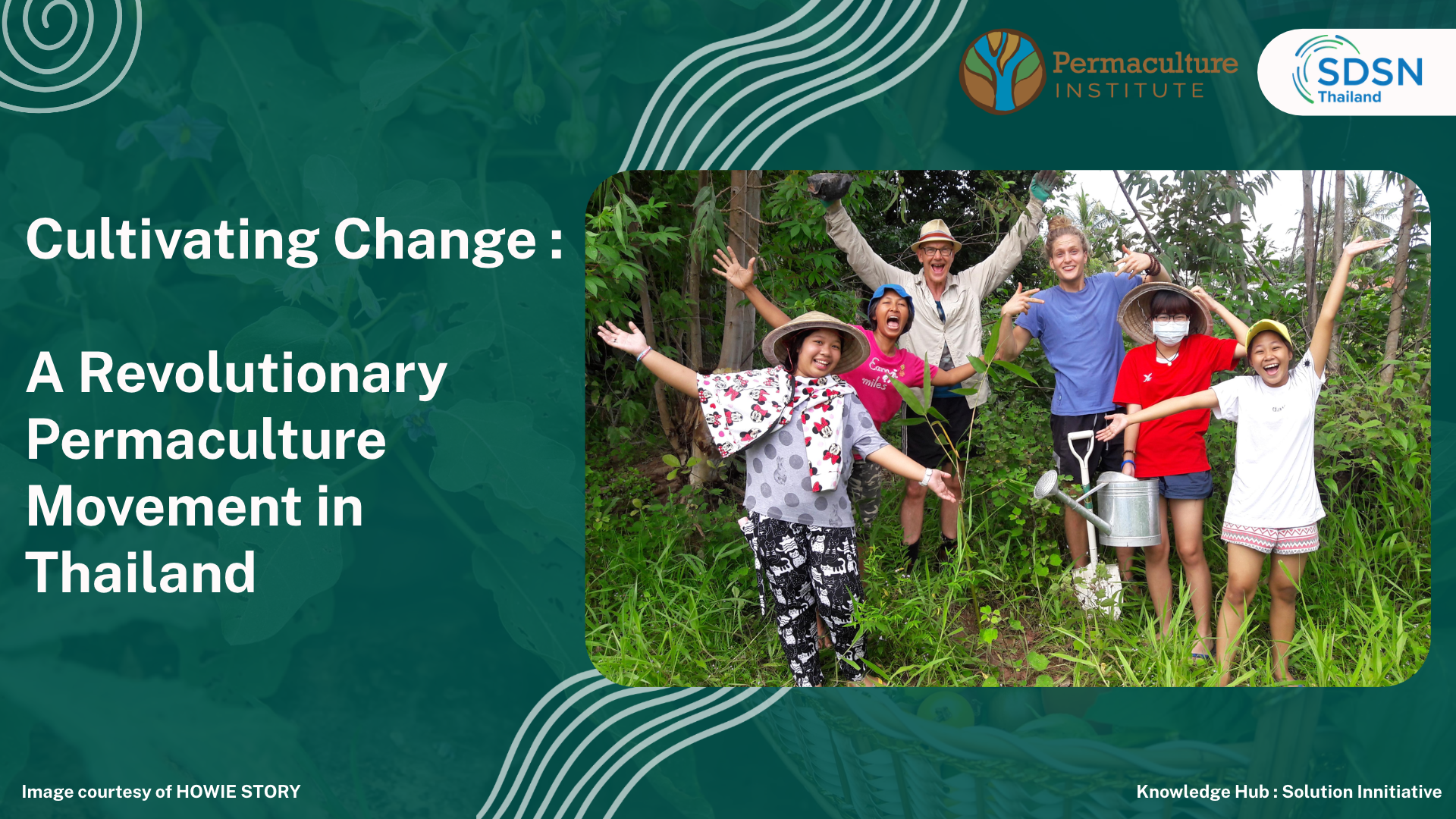
Cultivating Change: A Revolutionary Permaculture Movement in Thailand
In the verdant landscapes of Thailand’s Isaan region, where traditional rice paddies stretch toward distant horizons, a quiet revolution is taking root. At its center stands Howard Story, an internationally acclaimed permaculture teacher whose innovative approach to sustainable agriculture is transforming both the land and the lives of countless farmers across the kingdom. His most outstanding achievement; the establishment and expansion of the Permaculture Institute of Thailand, represents not merely an agricultural project, but a comprehensive reimagining of how humanity can live in harmony with the natural world.
Founded in 2013, the Permaculture Institute of Thailand represents Howard’s most ambitious and successful undertaking. Built upon the three core ethics of permaculture—care for the earth, care for the people, and fair share—the institute has grown from a single educational center to a network of four demonstration farms across the country, with its flagship location in Buriram province serving as both a teaching facility and a living laboratory.
What makes Howard’s approach truly revolutionary is not just the adoption of permaculture principles, but the innovative integration of modern technology with traditional wisdom. At the Buriram facility, students learn to harness multiple technologies and techniques in harmony: drones for precision agriculture monitoring, solar power for sustainable energy, vermiculture for natural fertilizer production, biochar creation for soil enhancement, and sophisticated water management systems that capture and utilize water from five different sources, including rainwater harvesting, well drilling, and pond construction.
The institute’s educational model is equally innovative. Rather than simply teaching theory, Howard created an immersive experience where up to 20 students at a time live and work on the farm, learning through direct hands-on experience. This approach extends beyond agriculture to encompass a holistic understanding of sustainable living, from natural building techniques to waste management systems.
Transforming Agricultural Economics
Perhaps the most impactful aspect of Howard’s work lies in its potential to transform the economic reality facing Thai farmers. His research revealed a sobering truth: rice farmers were spending 40 Thai Baht on fertilizers and another 5-8 Thai Baht on pesticides for every 100 Thai Baht they earned from their rice sales. This cycle of dependency on expensive chemical inputs was not only economically unsustainable but environmentally destructive.
Through the institute’s programs, Howard demonstrates how farmers can break this cycle by adopting permaculture techniques that utilize natural processing methods. By teaching farmers to create their own fertilizers from cow and chicken manure mixed with leaves and rice straws, the institute helps them potentially double their income while simultaneously healing the land. This approach addresses both immediate economic needs and long-term environmental sustainability—a rare combination in development work.
Building a Network of Change
Howard’s vision extends far beyond a single educational center. The institute has become the hub of a growing network that includes partnerships with established projects like the Panya Project in Chiang Mai, Gaia Ashram in Udon Thani, and TRT Farm, also in Udon Thani. Through the Worldwide Organization of Organic Farms of Thailand (WWOOF), the institute connects with 150 farmers and welcomes international volunteers, creating a vibrant community of knowledge exchange and cultural learning.
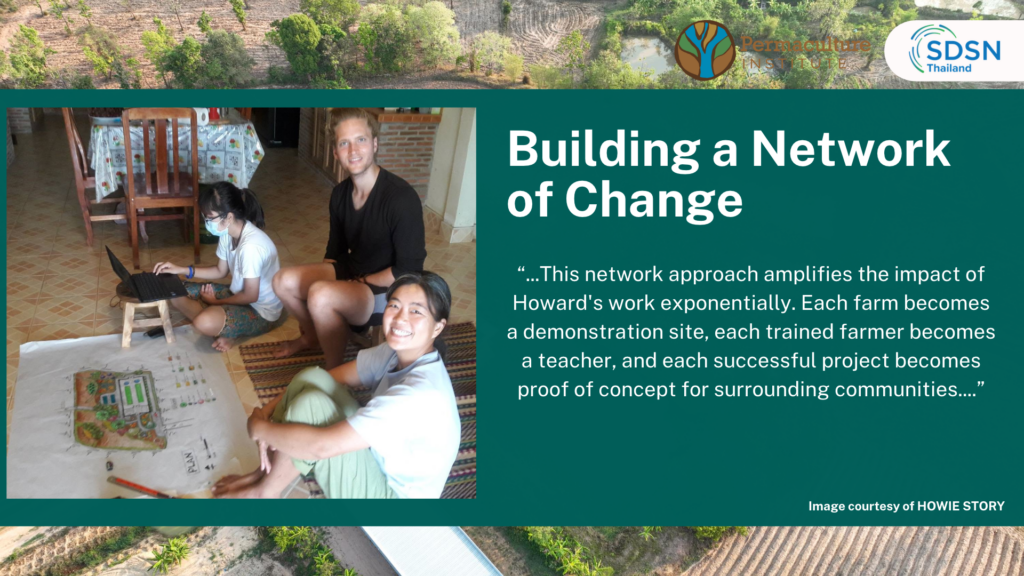
This network approach amplifies the impact of Howard’s work exponentially. Each farm becomes a demonstration site, each trained farmer becomes a teacher, and each successful project becomes proof of concept for surrounding communities. The institute’s collaboration with international schools in Bangkok further extends its reach, integrating permaculture principles into educational curricula and inspiring the next generation of environmental stewards.
Research and Evidence-Based Practice
What distinguishes Howard’s work from other well-intentioned development projects is its grounding in rigorous research and evidence-based practice. The institute doesn’t just promote permaculture as an ideology; it demonstrates its effectiveness through measurable outcomes. Students learn not just what to do, but why it works, understanding the scientific principles underlying natural systems.
The institute’s research encompasses multiple disciplines: soil science, hydrology, ecology, economics, and education. By integrating these fields, Howard has created a comprehensive approach to sustainable development that addresses root causes rather than symptoms. This multidisciplinary approach ensures that solutions are both environmentally sound and economically viable.
Global Impact with Local Roots
While the Permaculture Institute of Thailand is deeply rooted in local conditions and culture, its impact extends far beyond Thailand’s borders. The institute’s internationally recognized Permaculture Design Certificate course attracts students from around the world, creating a global network of practitioners who carry these principles back to their own communities.
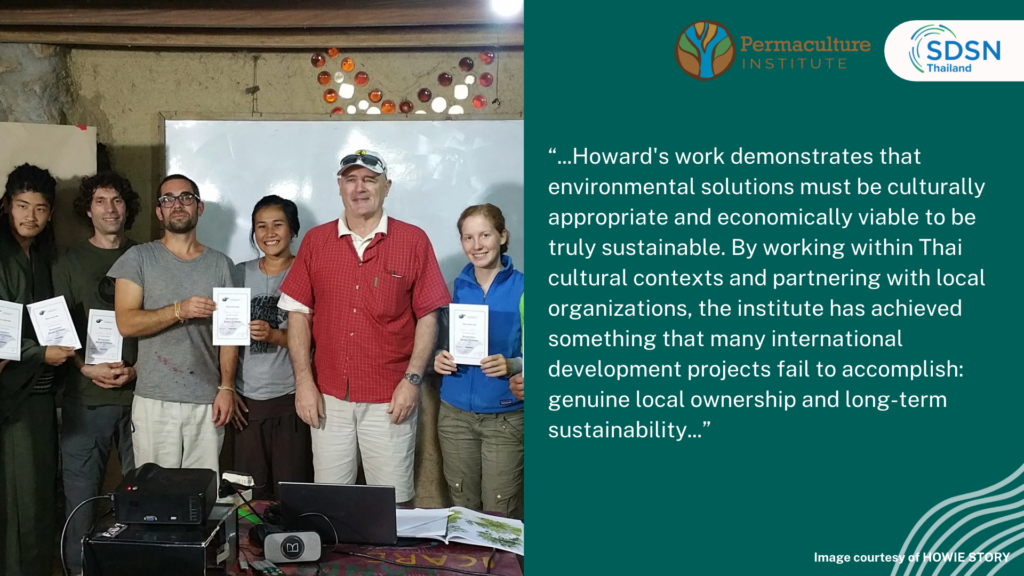
Howard’s work demonstrates that environmental solutions must be culturally appropriate and economically viable to be truly sustainable. By working within Thai cultural contexts and partnering with local organizations, the institute has achieved something that many international development projects fail to accomplish: genuine local ownership and long-term sustainability.
The Future of Permaculture in Thailand
As Thailand faces increasing environmental challenges—from air pollution in Bangkok to soil degradation in rural areas—Howard’s work offers a roadmap for a more sustainable future. The institute’s success has attracted attention from businesses, schools, and restaurants seeking to incorporate more sustainable practices into their operations.
The growing adoption of permaculture principles by Thai farmers provides concrete evidence that this approach can work at scale. As more farmers experience improved incomes and healthier soils, the movement gains momentum organically. This grassroots growth, supported by the institute’s educational programs, suggests that permaculture in Thailand is moving from experimental to mainstream.
Howard Story’s Permaculture Institute of Thailand represents more than an agricultural project; it embodies a fundamental reimagining of the relationship between humans and the natural world. By combining traditional wisdom with modern technology, rigorous research with hands-on practice, and local knowledge with global perspectives, Howard has created a model for sustainable development that addresses the interconnected challenges of our time.
The institute’s success lies not just in its innovative techniques or impressive outcomes, but in its ability to inspire and empower others. Each farmer who adopts permaculture principles, each student who learns to see the world through ecological eyes, and each community that embraces sustainable practices becomes part of a growing movement toward a more sustainable future.


