
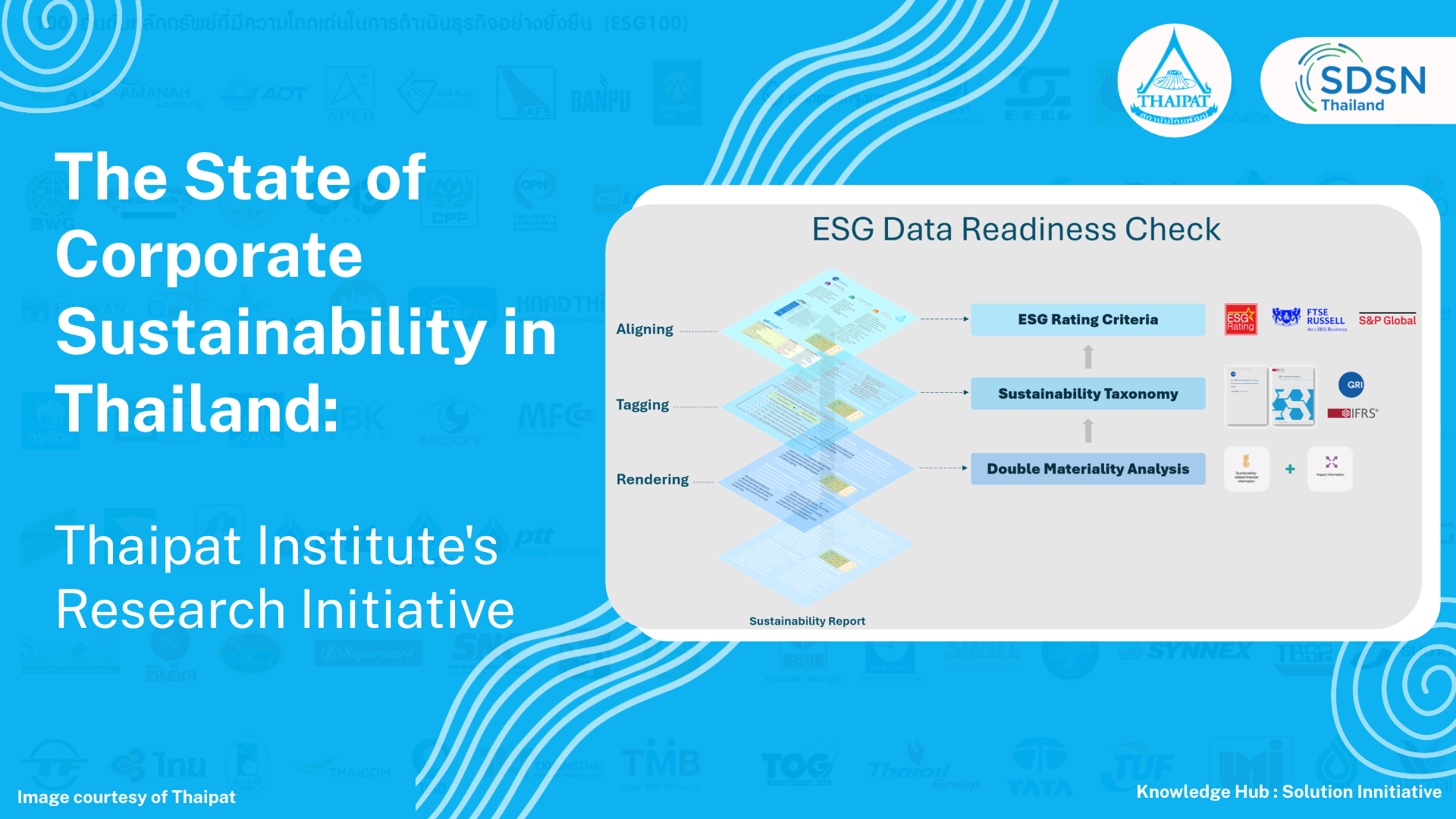
The State of Corporate Sustainability in Thailand: Thaipat Institute’s Research Initiative
In an era where corporate sustainability has become paramount to business success and societal wellbeing, Thailand’s commitment to environmental, social, and governance (ESG) practices has gained increasing attention from investors, regulators, and stakeholders worldwide. At the forefront of this movement stands Thaipat Institute, a pioneering organization that has been systematically documenting and analyzing the evolution of corporate sustainability in Thailand through its comprehensive research initiative titled “The State of Corporate Sustainability in Thailand.” This biennial research program represents one of the most significant efforts to understand and promote sustainable business practices in Southeast Asia.
Background and Evolution
Thaipat Institute’s research initiative emerged from a recognition that Thailand’s corporate sector needed a systematic approach to measure, benchmark, and improve sustainability performance. As Thailand’s economy has grown and integrated more deeply into global supply chains, the pressure for transparent and accountable sustainability reporting has intensified. The institute’s research fills a critical gap by providing empirical data and analysis that helps businesses, investors, and policymakers understand the current state of corporate sustainability in the country.
The research initiative has evolved significantly since its inception, expanding both in scope and sophistication. What began as a focused assessment of sustainability disclosure practices has grown into a comprehensive evaluation framework that examines multiple dimensions of corporate sustainability performance. This evolution reflects both the maturation of Thailand’s sustainability landscape and the increasing complexity of global sustainability challenges.
Methodology and Scope
The research initiative employs a robust methodology that combines quantitative data collection with qualitative analysis. The scope of the research is impressive in its breadth, with the 2024 report examining information from 838 listed companies and 92 other entities, totaling 930 organizations. This comprehensive sample size provides a reliable foundation for understanding trends and patterns across Thailand’s corporate landscape.
The methodology encompasses several key analytical frameworks that provide different perspectives on sustainability performance. The research team employs a multi-dimensional approach that ensures comprehensive coverage of sustainability issues while maintaining analytical rigor. This approach allows for both sector-specific insights and cross-industry comparisons, providing valuable benchmarking opportunities for participating organizations.
Key Analytical Dimensions
- Sustainability Disclosure Status Assessment
The first major component of the research focuses on evaluating the overall status of sustainability disclosure in Thailand. This analysis provides both international context and Thailand-specific insights, examining the rate at which Thai companies are releasing dedicated ESG and sustainability reports. The research also assesses the integration of sustainability information into annual reports, particularly through Thailand’s Form 56-1 One Report format.
This dimension of the research is particularly valuable because it tracks the fundamental transparency that underpins all other sustainability efforts. Without proper disclosure, stakeholders cannot assess corporate sustainability performance, making this metric a crucial foundation for the entire sustainability ecosystem.
- GRI-Perspective Sustainability Issue Analysis
The research employs the Global Reporting Initiative (GRI) Standards as a framework for analyzing sustainability development across various industry groups. This approach provides international comparability while identifying the most frequently disclosed sustainability issues within economic, social, and environmental dimensions. The GRI perspective is particularly valuable because it represents globally accepted standards for sustainability reporting, allowing Thai companies to benchmark their performance against international best practices.
The analysis reveals sector-specific sustainability priorities and helps identify gaps where Thai companies might need to enhance their reporting and performance. This dimension of the research provides actionable insights for companies seeking to improve their sustainability strategies and reporting practices.
- WFE-Perspective ESG Issue Analysis
The World Federation of Exchanges (WFE) framework provides another analytical lens through which the research examines corporate sustainability performance. This perspective focuses on ESG issues that are particularly relevant to publicly traded companies and their stakeholders. The research assesses the performance of each industry group regarding these ESG issues and provides targeted recommendations for improvement.
This analysis is particularly valuable for investors and financial institutions that need to understand ESG risks and opportunities across different sectors. The WFE perspective helps bridge the gap between sustainability performance and financial materiality, making the research findings more actionable for investment decisions.
- SDG-Perspective GCI Analysis
The research also examines how companies across different industry groups are responding to the United Nations Sustainable Development Goals (SDGs) through their business processes. This SDG-in-process analysis aligns with the Guidance on Core Indicators (GCI) developed by UNCTAD, providing a framework for understanding how corporate activities contribute to global sustainability objectives.
This dimension of the research is increasingly important as stakeholders seek to understand how corporate activities contribute to broader societal goals. The SDG perspective helps companies understand their role in addressing global challenges while identifying opportunities for positive impact.
Impact and Applications
- Business Intelligence and Strategic Planning
For businesses already committed to sustainable development, the research provides valuable intelligence for strategic planning and performance improvement. Companies can use the findings to understand current trends, identify emerging issues, and benchmark their performance against industry peers. This information is particularly valuable for sustainability managers and corporate strategists who need to make informed decisions about resource allocation and priority setting.
The research also helps companies understand stakeholder expectations and regulatory trends, enabling proactive rather than reactive sustainability strategies. By providing sector-specific insights, the research allows companies to tailor their sustainability approaches to their particular industry contexts while maintaining awareness of broader trends.
- Investment Decision Support
The research initiative plays a crucial role in supporting sustainable investment decisions. Institutional and individual investors increasingly rely on ESG data to make informed investment choices, and the research provides comprehensive, standardized information that facilitates these decisions. The connection between the research and initiatives like the ESG100 list demonstrates how academic research can translate into practical investment tools.
For investors, the research provides both quantitative metrics and qualitative insights that help assess sustainability risks and opportunities. This information is particularly valuable in emerging markets like Thailand, where sustainability data may be less readily available than in more developed markets.
- Policy and Regulatory Guidance
The research findings also inform policy development and regulatory frameworks. By providing empirical evidence about corporate sustainability performance, the research helps policymakers understand the current state of practice and identify areas where additional support or regulation might be needed. This evidence-based approach to policy development is particularly important in the rapidly evolving field of sustainability regulation.
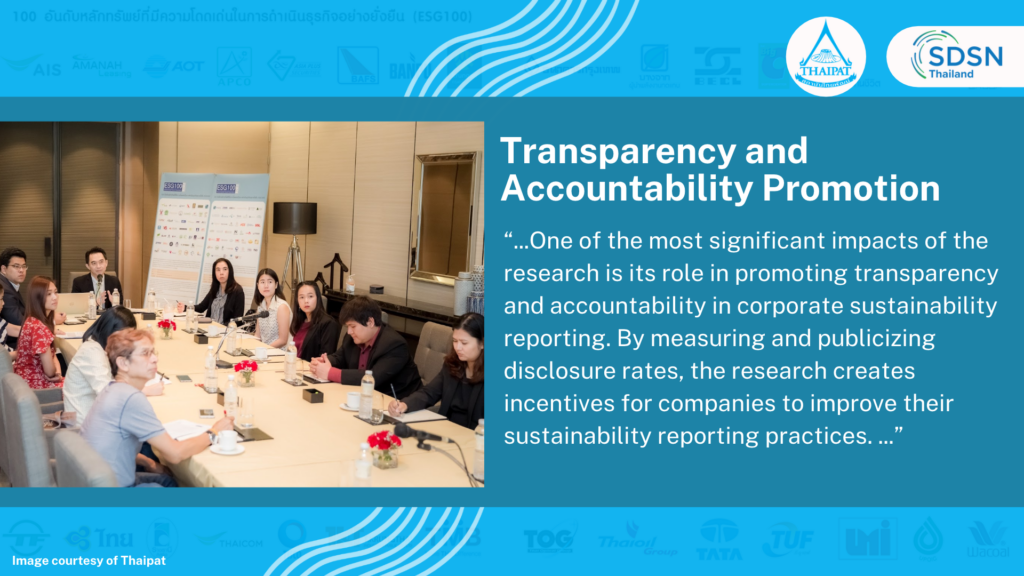
- Transparency and Accountability Promotion
One of the most significant impacts of the research is its role in promoting transparency and accountability in corporate sustainability reporting. By measuring and publicizing disclosure rates, the research creates incentives for companies to improve their sustainability reporting practices. This positive pressure helps drive continuous improvement in sustainability disclosure across the Thai corporate sector.
Recent Developments and Innovations
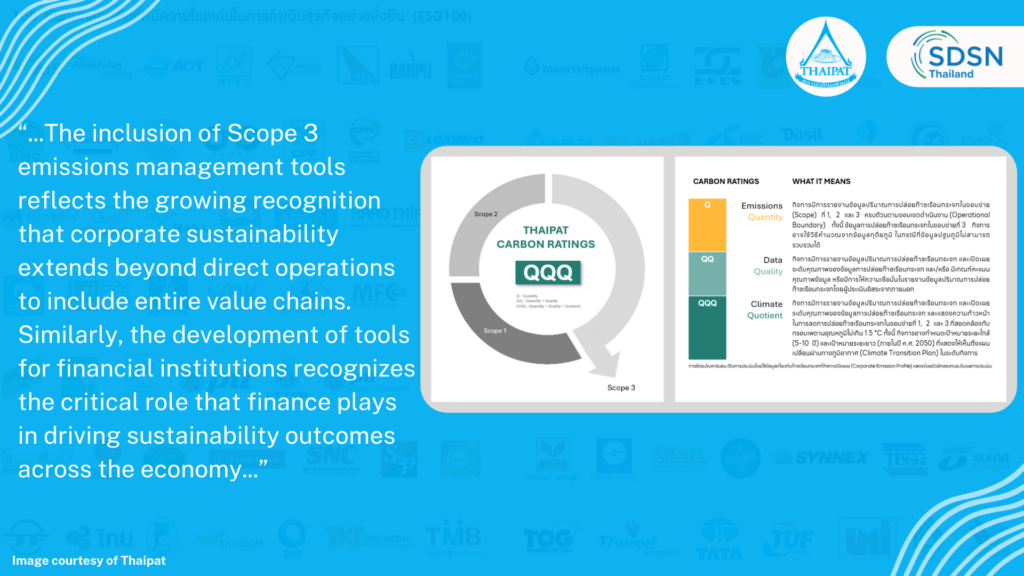
The 2024 iteration of the research introduced several innovative elements that reflect the evolving nature of sustainability challenges and opportunities. The research now includes tools such as S3ER (Scope 3 Emissions Reduction) for managing atmospheric emissions in the third scope (Value Chain) of businesses, and TCAF (Thaipat Carbon Attribution Factors) for managing atmospheric emissions resulting from investment and lending by financial institutions.
These new tools represent significant advances in the sophistication of sustainability measurement and management. The inclusion of Scope 3 emissions management tools reflects the growing recognition that corporate sustainability extends beyond direct operations to include entire value chains. Similarly, the development of tools for financial institutions recognizes the critical role that finance plays in driving sustainability outcomes across the economy.
Challenges and Limitations
Despite its comprehensive nature, the research initiative faces several challenges and limitations. One significant challenge is the varying quality and completeness of corporate sustainability reporting, which can affect the reliability of comparative analyses. While the research methodology attempts to address these issues through standardized frameworks, the underlying data quality remains a constraint.
Another challenge is the rapid pace of change in sustainability standards and expectations. As new frameworks emerge and existing standards evolve, the research must continuously adapt its methodology to remain relevant and useful. This requires ongoing investment in research capability and methodology development.
The research also faces the challenge of balancing comprehensiveness with accessibility. While detailed analysis is valuable for specialists, the research must also be accessible to a broader audience of business leaders, investors, and policymakers who may not have deep technical expertise in sustainability measurement.
Future Directions and Opportunities
Looking forward, the research initiative has several opportunities for continued development and impact. One significant opportunity is the integration of emerging technologies such as artificial intelligence and machine learning to enhance data collection and analysis capabilities. These technologies could enable more sophisticated pattern recognition and predictive analytics, providing even greater value to users.
Another opportunity lies in expanding the research to include more small and medium-sized enterprises (SMEs), which represent a significant portion of Thailand’s economy but may not be captured in current analyses focused on listed companies. Understanding sustainability practices among SMEs could provide a more complete picture of Thailand’s corporate sustainability landscape.
The research could also benefit from enhanced international collaboration, particularly with similar initiatives in other Southeast Asian countries. Regional cooperation could provide valuable comparative insights and support the development of regional sustainability standards and best practices.
In conclusion, Thaipat Institute’s “The State of Corporate Sustainability in Thailand” research initiative represents a critical contribution to understanding and promoting sustainable business practices in Thailand. Through its comprehensive methodology, multi-dimensional analysis, and practical applications, the research provides valuable insights for businesses, investors, and policymakers seeking to navigate the complex landscape of corporate sustainability.
The initiative’s evolution from a basic disclosure assessment to a sophisticated analytical framework reflects both the maturation of Thailand’s sustainability landscape and the increasing complexity of global sustainability challenges. As the research continues to develop and adapt, it will undoubtedly play an increasingly important role in driving Thailand’s transition to a more sustainable economy.
The research’s impact extends beyond mere documentation of current practices to actively promoting transparency, accountability, and continuous improvement in corporate sustainability performance. By providing reliable, comprehensive data and analysis, the initiative helps create the foundation for informed decision-making and strategic planning across Thailand’s corporate sector.
As Thailand continues to integrate into global supply chains and face increasing scrutiny from international stakeholders, the importance of robust sustainability measurement and reporting will only grow. Thaipat Institute’s research initiative provides the empirical foundation needed to support this evolution, making it an invaluable resource for all stakeholders committed to building a more sustainable future for Thailand and the broader region.


