
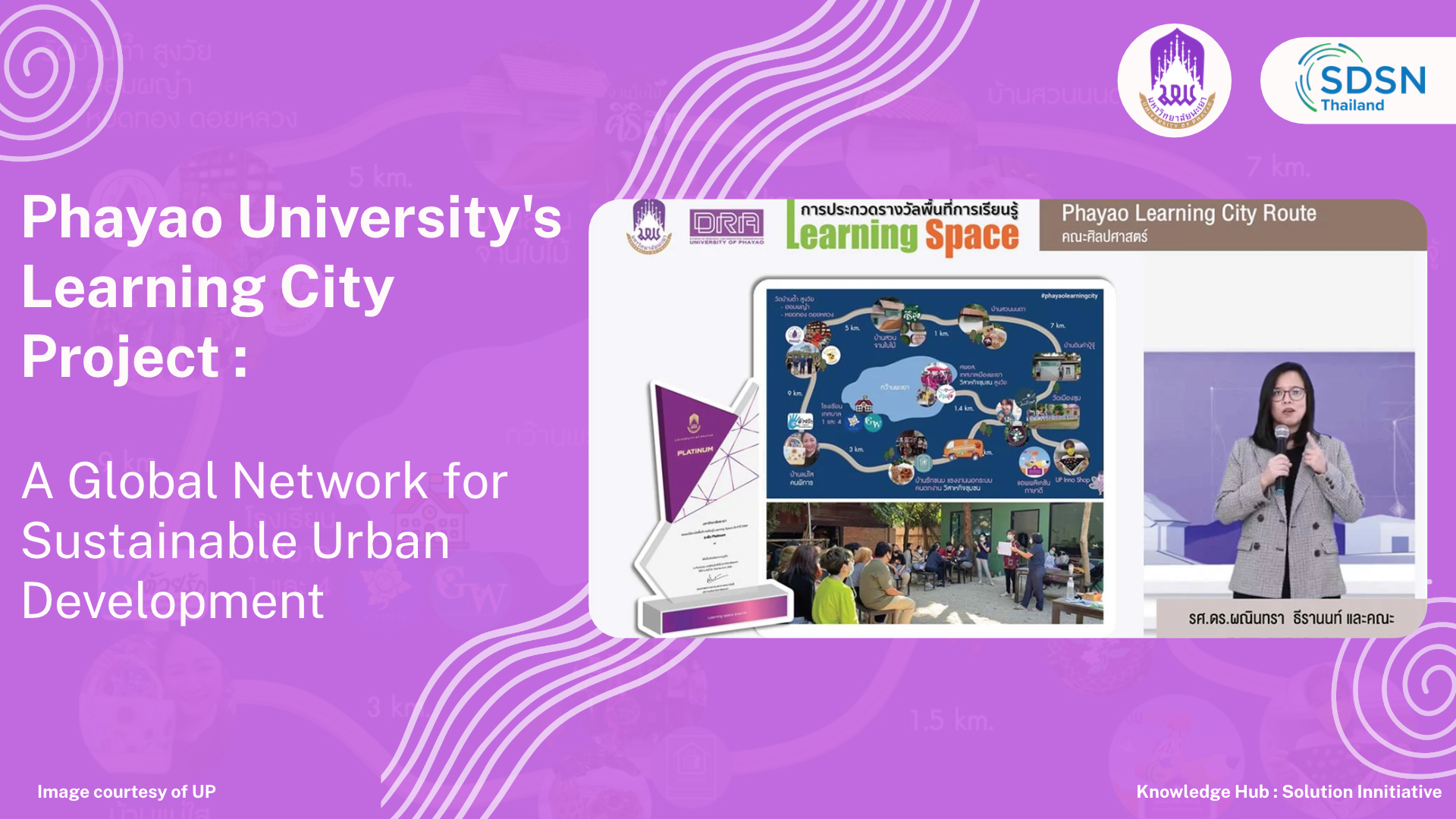
Phayao University’s Learning City Project: A Global Network for Sustainable Urban Development
Under the visionary leadership of Assoc. Prof. Dr. Phanintra Teeranon, Assistant to the President of Phayao University has spearheaded an ambitious learning city initiative that transcends traditional boundaries of education and urban development. What began as a localized project has evolved into a comprehensive network spanning 34 areas across Thailand and extending internationally through innovative mentorship systems and sister city partnerships. This transformative initiative represents a paradigm shift in how communities approach lifelong learning, sustainable development, and cross-cultural collaboration.
The Foundation: Thailand’s National Learning City Network
The learning city project overseen by Dr. Phanintra Teeranon has established a robust foundation across Thailand, creating a network of 34 learning cities that serve as laboratories for educational innovation and sustainable urban development. This national framework operates on the principle that cities themselves can become platforms for continuous learning, where residents, institutions, and governance structures work collaboratively to address local challenges while contributing to broader educational and developmental goals.
The Thai learning city model emphasizes the integration of formal and informal learning opportunities within urban environments. Rather than confining education to traditional classroom settings, these cities transform public spaces, community centers, local businesses, and cultural institutions into dynamic learning environments. This approach recognizes that learning is not merely an individual pursuit but a collective endeavor that can drive social cohesion, economic development, and environmental sustainability.
International Expansion Through Mentorship
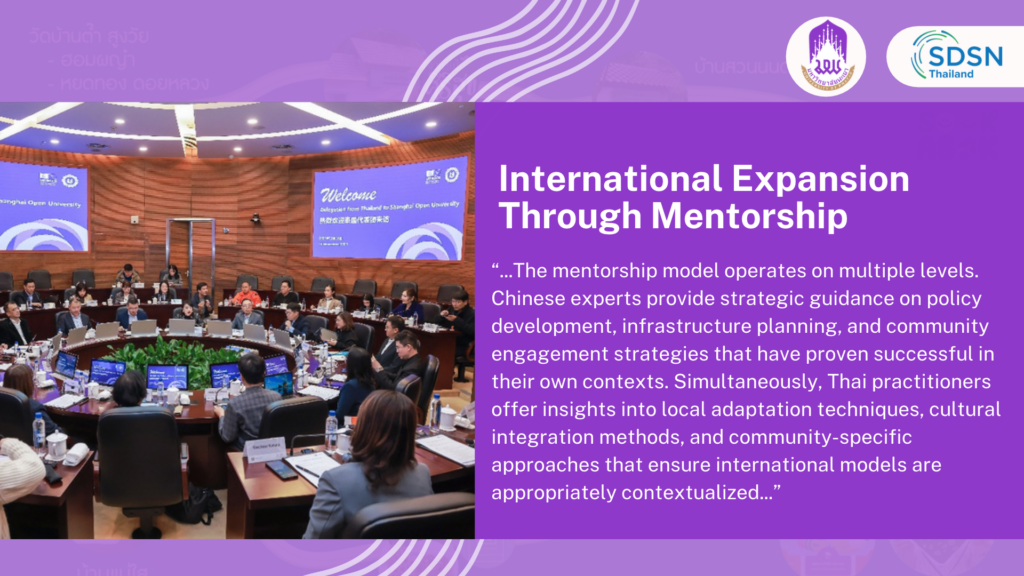
The project’s international dimension represents one of its most innovative aspects. By establishing a mentorship system that brings experienced learning city practitioners from China to guide Thai initiatives, the project demonstrates how knowledge transfer can occur across national boundaries while respecting local contexts and cultural specificities. This China-Thailand collaboration exemplifies South-South cooperation in education, where developing nations share expertise and resources to address common challenges.
The mentorship model operates on multiple levels. Chinese experts provide strategic guidance on policy development, infrastructure planning, and community engagement strategies that have proven successful in their own contexts. Simultaneously, Thai practitioners offer insights into local adaptation techniques, cultural integration methods, and community-specific approaches that ensure international models are appropriately contextualized.
This bidirectional knowledge exchange challenges traditional notions of educational cooperation, which often follow North-South patterns. Instead, it creates a more equitable framework where both mentors and mentees contribute valuable perspectives, fostering mutual learning and respect.
Domestic Knowledge Sharing and Peer Learning
Within Thailand’s borders, the project has established an equally innovative peer-to-peer mentorship system. Provinces serve as mentors to one another, creating a dynamic network where successful learning city implementations become resources for emerging initiatives. This domestic knowledge sharing mechanism ensures that lessons learned in one region can be rapidly disseminated and adapted across the country.
The peer mentorship model recognizes that each province brings unique strengths, resources, and challenges to the learning city concept. Urban centers might excel in technology integration and digital learning platforms, while rural areas might demonstrate superior community engagement and traditional knowledge preservation. By facilitating exchanges between these diverse contexts, the project creates a rich tapestry of learning experiences that strengthens the entire network.
Alignment with Sustainable Development Goals
The integration of Sustainable Development Goals (SDGs) into the learning city framework demonstrates the project’s commitment to global development priorities. By aligning data collection and outcome assessment with relevant SDGs, the initiative ensures that local learning activities contribute to broader international development objectives. This alignment is particularly significant in areas such as Quality Education (SDG 4), Sustainable Cities and Communities (SDG 11), and Partnerships for the Goals (SDG 17).
The SDG integration serves multiple purposes. It provides a standardized framework for measuring and comparing outcomes across different learning cities, both within Thailand and internationally. It also ensures that local initiatives contribute to global progress tracking, making the learning city network a valuable contributor to international development reporting. Furthermore, this alignment helps secure international funding and support by demonstrating clear connections between local activities and global priorities.
Sister City Partnerships: A Model for International Collaboration
The “sister city” partnership model that has been operational for approximately one year represents a sophisticated approach to international educational cooperation. Unlike traditional sister city relationships that often focus on cultural exchange and economic cooperation, these partnerships specifically target learning and knowledge sharing as their primary objectives.
The sister city framework facilitates systematic exchanges of best practices, joint research initiatives, and collaborative problem-solving approaches. Cities within the network can share challenges and solutions in real-time, creating a responsive support system that adapts to emerging needs and opportunities. This collaborative approach has proven particularly valuable in addressing complex urban challenges that require interdisciplinary solutions and multi-stakeholder engagement.
Innovation and Effectiveness Through Collaboration
The international expansion of the learning city project has generated significant innovation in both educational methodology and urban management. The cross-regional learning exchanges have produced new approaches to community engagement, technology integration, and resource optimization that would not have emerged within isolated local contexts. These innovations have enhanced the clarity and effectiveness of the learning city model, making it more adaptable and scalable across diverse cultural and economic contexts.
The collaborative nature of the project has also strengthened its research and development capabilities. By combining insights from multiple cultural contexts, the network has developed more nuanced understandings of how learning cities can address different types of urban challenges. This research capacity has positioned the Phayao University-led initiative as a significant contributor to international scholarship on learning cities and sustainable urban development.
Future Implications and Scalability
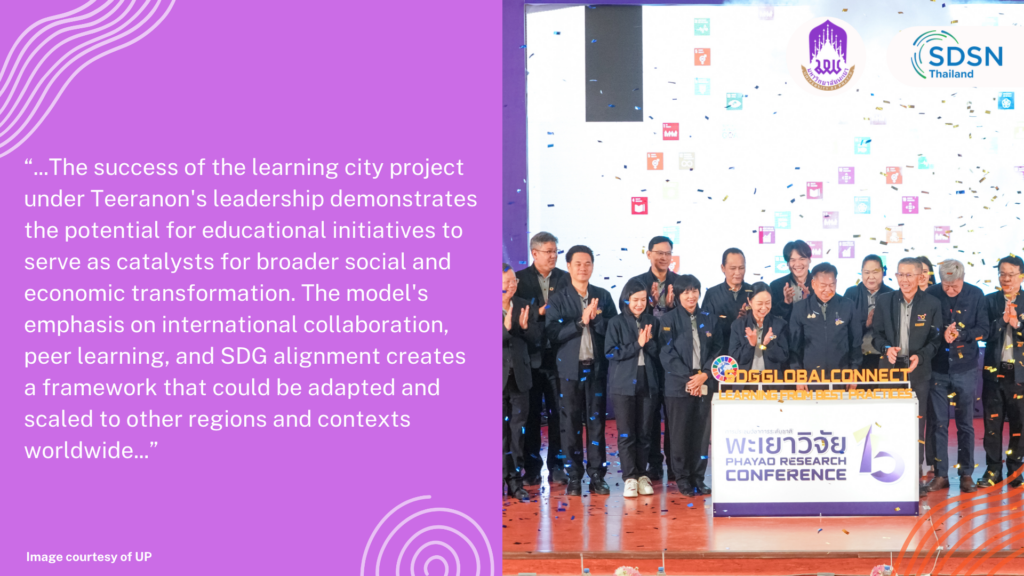
The success of the learning city project under Teeranon’s leadership demonstrates the potential for educational initiatives to serve as catalysts for broader social and economic transformation. The model’s emphasis on international collaboration, peer learning, and SDG alignment creates a framework that could be adapted and scaled to other regions and contexts worldwide.
The project’s integration of traditional knowledge systems with modern educational technologies offers valuable insights for other developing nations seeking to modernize their educational systems while preserving cultural heritage. The mentorship model provides a sustainable mechanism for knowledge transfer that could be replicated in other sectors beyond education.
Dr. Phanintra Teeranon’s leadership of Phayao University’s learning city project represents a transformative approach to educational development that successfully bridges local needs with global opportunities. Through its innovative combination of national network building, international mentorship, peer learning, and SDG alignment, the project has created a model that demonstrates how universities can serve as catalysts for sustainable urban development and international cooperation.
The project’s success in creating vibrant cross-regional learning exchanges and generating innovative approaches to urban management validates the learning city concept as a powerful tool for addressing complex contemporary challenges. As the initiative continues to evolve and expand, it offers valuable lessons for other institutions and communities seeking to harness the transformative potential of learning-centered urban development.
The international dimension of the project particularly highlights the importance of South-South cooperation in addressing global development challenges. By creating networks that facilitate knowledge sharing among developing nations, the initiative contributes to a more equitable and sustainable model of international development cooperation that respects local contexts while advancing global goals.


