
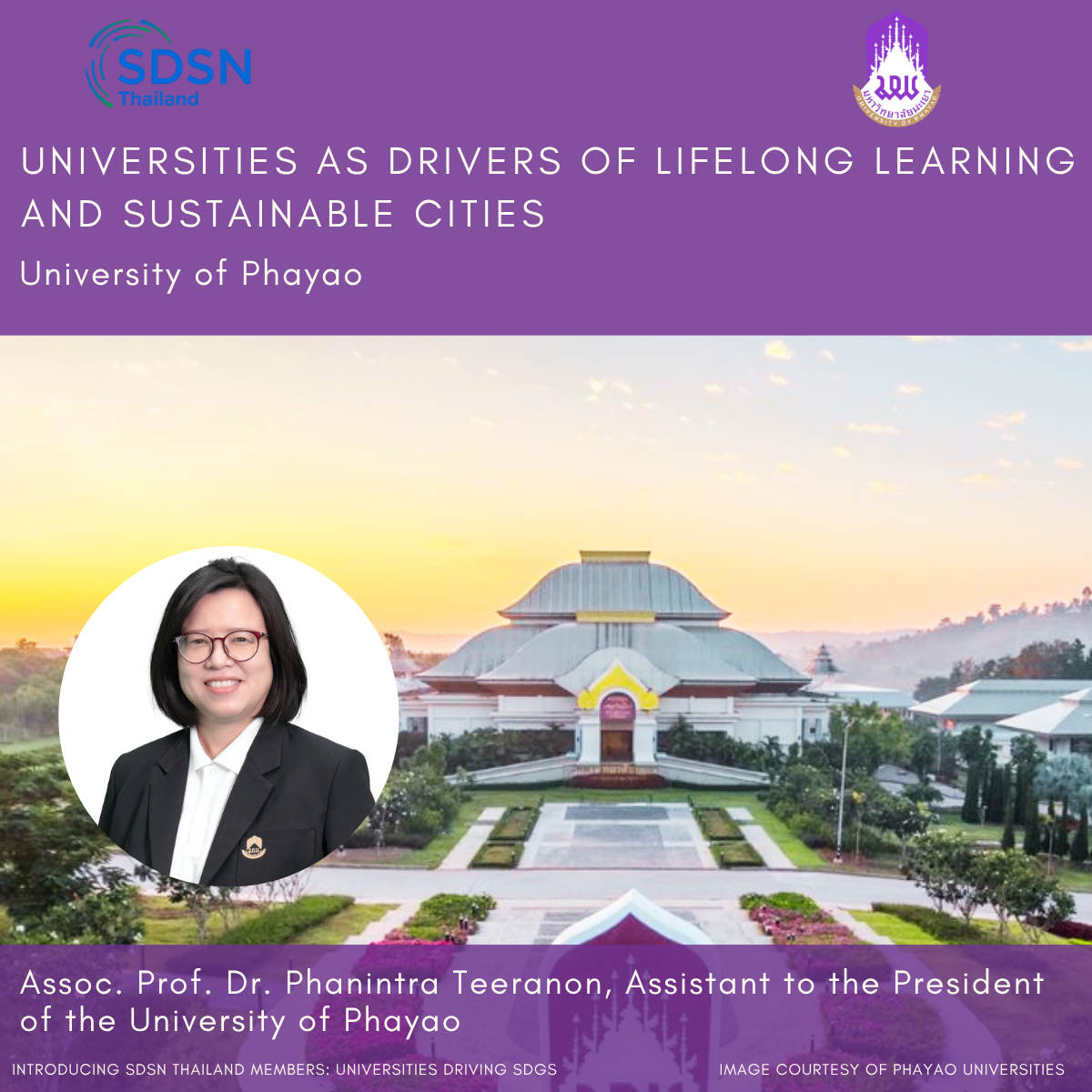
Universities as Drivers of Lifelong Learning and Sustainable Cities : Insights from University of Phayao
Continuing our introduction of SDSN Thailand member institutions, we are pleased to highlight the University of Phayao and its work in advancing sustainable development through lifelong learning and the development of a learning city. The university’s approach demonstrates how education can extend beyond formal institutions by connecting local knowledge, innovation, community participation, and economic opportunities to address the needs of people and communities. In Phayao, the concept of a learning city is being translated into practice through inclusive learning spaces that bring together people of all ages while drawing on the province’s rich cultural heritage and local wisdom.
In this article, we invite you to explore the vision and experience behind these efforts through an exclusive interview with Assoc. Prof. Dr. Phanintra Teeranon, Assistant to the President of the University of Phayao. She shares insights into the role of lifelong learning in sustainable development, the Phayao Learning Center, and how local knowledge, innovation, and partnerships can create lasting benefits for communities and advance the SDGs.
SDSN Thailand:How do you view “learning,” and why is a learning city important for sustainable development?
Assoc. Prof. Dr.Phanintra : When discussing learning in the context of a learning city, I would first emphasize that a learning city is essentially a process; a continuous process of human development that integrates lifelong learning. Based on my research over the past five years, a learning city is not just a place but a dynamic system where people of all ages; children, working adults, and the elderly have opportunities to engage in learning throughout their lives.
The core idea is to provide access to learning processes for everyone, ensuring inclusivity across all life stages. This lifelong learning happens not only through formal education systems such as schools and universities but also, and perhaps more importantly, through informal and non-formal learning spaces. While formal institutions do open their doors to the public regardless of age or background, the emphasis in a learning city often lies in creating and nurturing non-formal learning environments that encourage creativity and participation.
Every learning city must be tailored to its unique history and cultural background. For example, in Phayao, the local wisdom surrounding Kwan Phayao Lake and the ancient temples submerged beneath its waters serve as rich learning resources. These temples, visible when water levels drop, have been centers of knowledge since ancient times. By drawing on this local heritage and the wisdom of the communities around the lake, the Phayao Learning Center enables people of all ages to access and appreciate this indigenous knowledge. Moreover, this approach helps generate income and economic opportunities for the community, linking learning directly to sustainable livelihoods.
Thus, the development of a learning city fundamentally involves two main components:
- Human Development Across All Ages: Ensuring that people at every stage of life have access to learning opportunities.
- Learning Spaces: Creating safe, creative, and inclusive spaces where individuals of all genders and ages can engage in lifelong learning.
Another important aspect is the evaluation of how effectively these learning opportunities reach the community. The criteria for success depend on the local government’s priorities and the specific challenges faced by the area. For instance, if a community struggles with low income, the learning spaces should aim to generate income for participants, and success would be measured by the economic benefits gained through learning. Alternatively, if the community faces issues related to well-being or happiness, the learning process should focus on enhancing quality of life, with success measured by improvements in mental health or social satisfaction.
Common metrics include the number of learners, the frequency of participation, income generated through learning, and improvements in happiness or mental health; each tailored to address the community’s unique needs.
From my perspective, learning is an endless journey that spans the entire lifespan of every individual. This continuous learning journey must be coupled with the ability to adapt and grow alongside societal changes at the local, national, and global levels. In other words, learning equips people with the skills to adjust to the evolving world around them.
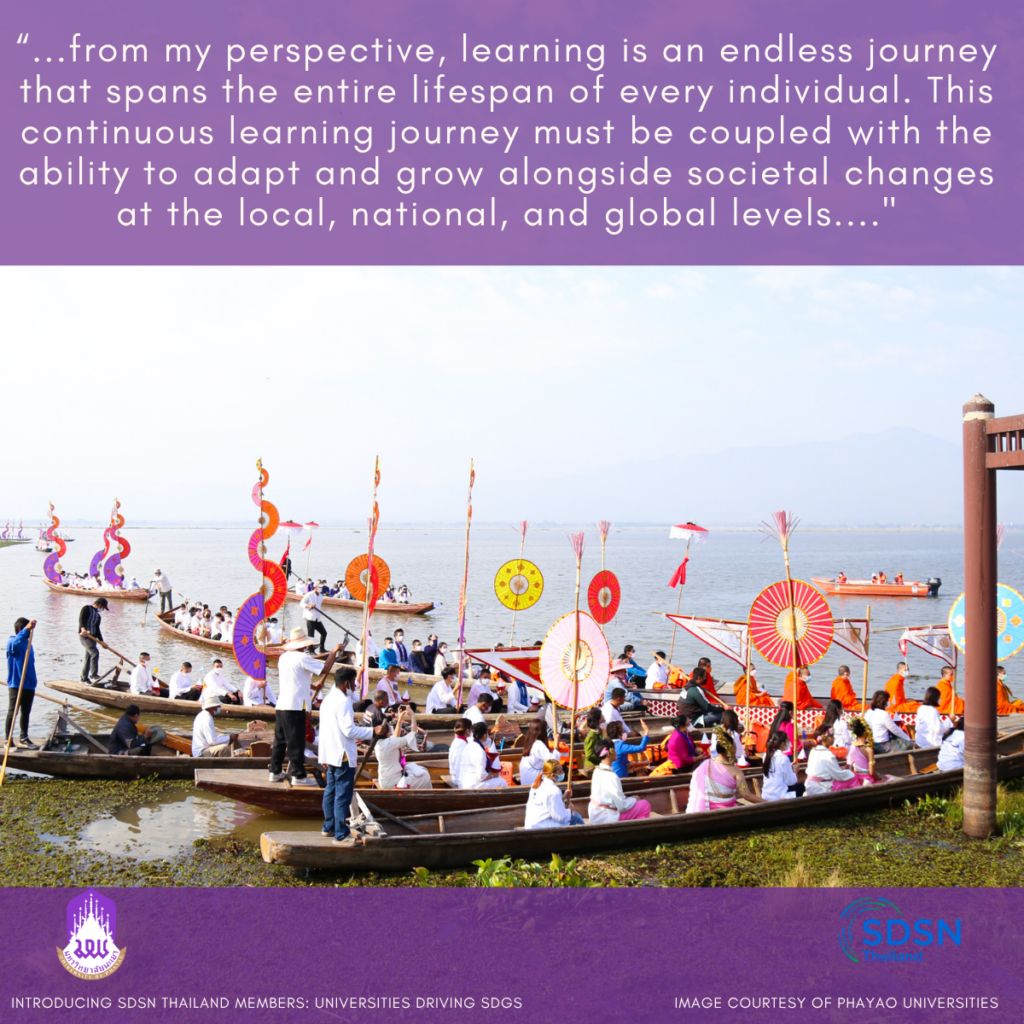
Such adaptation must be sustainable, enabling individuals to live fulfilling lives aligned with their aspirations and desires. This sustainability is closely linked to the concept of sustainable development. The learning process, therefore, is not just about acquiring knowledge but about fostering resilience and sustainable growth for both individuals and communities.
SDSN Thailand:How do you see the connection between a learning city and the Sustainable Development Goals (SDGs)?
Assoc. Prof. Dr.Phanintra : The concept of a learning city plays a crucial role as a driving force behind the achievement of the Sustainable Development Goals (SDGs). From my understanding, while SDG 16 (peace, justice, and strong institutions) and SDG 17 (partnerships for the goals) are essential, focusing on fundamental human rights and the necessity of collaboration; SDG 4 (quality education) stands out as the foundational infrastructure for both the learning city and sustainable development as a whole.
Without access to learning, people cannot adapt to change, nor would they be aware of their rights as outlined in SDG 16. They also would not understand the importance of building networks and partnerships, which are critical for collective progress and are emphasized in SDG 17. In this sense, SDG 4 is like the basic infrastructure of a city; comparable to building roads or installing streetlights that enable access and connectivity for everyone.
Therefore, I view SDG 4 as the essential groundwork upon which all other sustainable development efforts depend. It provides the foundation that empowers individuals to understand their rights, engage with networks, and ultimately contribute to the broader goals of peace, justice, and partnership. This perspective comes from my experience working on the development of learning cities, where education and lifelong learning are the pillars enabling sustainable growth and community resilience.
SDSN Thailand:How does the Phayao Learning Center project create participatory learning spaces and integrate local knowledge with modern disciplines in developing a learning city?
Assoc. Prof. Dr.Phanintra : Currently, we are integrating local wisdom, such as traditional hand embroidery, which is a unique stitching technique that creates very durable products like coin purses. This method differs significantly from ordinary sewing. For example, we combine this traditional craft with social innovation and technology. Learning takes place through online platforms and websites, connecting with social innovation initiatives. One creative example is using stories about endangered species in Kwan Phayao, such as the pufferfish, to inspire designs on these embroidered bags. This approach aligns with the BCG (Bio-Circular-Green) economic model, blending biological and ecological knowledge to raise awareness about conservation. Buyers of these products not only receive a functional item but also learn about the importance of preserving local natural resources around Kwan Phayao and how to protect them. This creates a social innovation process that fosters environmental consciousness alongside economic benefits.
Another example involves combining technology related to spirulina algae with traditional local snacks, which represent Phayao’s indigenous knowledge. For instance, we have developed a local pastry infused with spirulina, which has been researched, tested, and cultivated locally. This innovation has been licensed and proven to benefit bone health by aiding recovery and strengthening bones. This fusion of traditional food wisdom and modern scientific innovation generates income through learning processes conducted in collaboration with universities.
Beyond income generation, we also focus on sustainability aligned with the SDGs. Communities involved in learning these innovations and technologies become capable of expanding the knowledge further—they do not remain mere learners but become teachers themselves. This multiplier effect helps spread SDG 4 (quality education) across other communities throughout Phayao province, not just those around Kwan Phayao. These learners now teach in remote districts, extending the impact of education and innovation. This expansion supports not only SDG 8 (decent work and economic growth) but also SDG 11 (sustainable cities and communities).
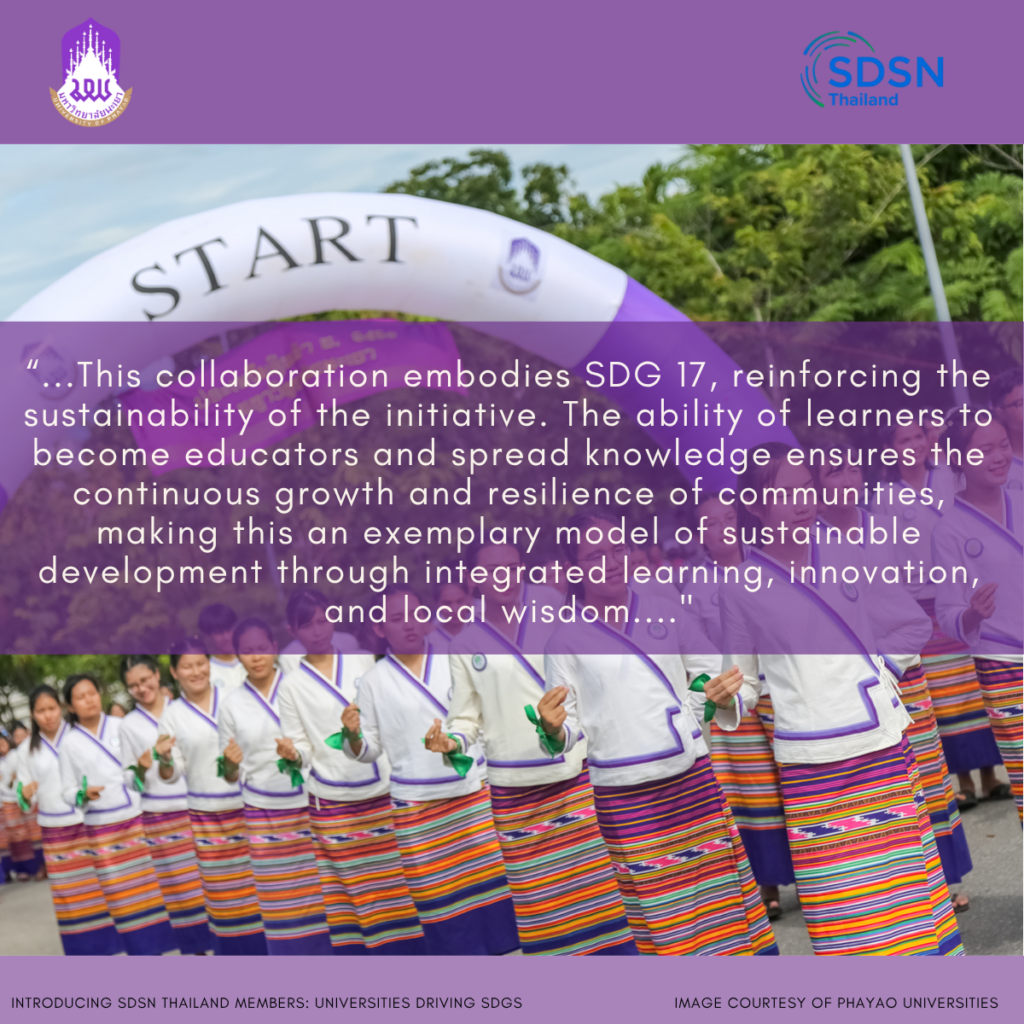
Local governments such as municipalities and provincial administrative organizations play a crucial role as partners, providing support alongside external funding sources. This collaboration embodies SDG 17 (partnerships for the goals), reinforcing the sustainability of the initiative. The ability of learners to become educators and spread knowledge ensures the continuous growth and resilience of communities, making this an exemplary model of sustainable development through integrated learning, innovation, and local wisdom.
SDSN Thailand:What challenges have you encountered in working long-term with the government, communities, or other sectors?
Assoc. Prof. Dr.Phanintra : One of the primary challenges we faced at the beginning was raising awareness and helping people understand the concept of lifelong learning, which aligns with SDG 4, and how it integrates with SDG 8 (decent work and economic growth) and SDG 17 (partnerships for the goals). It was difficult to ensure that everyone in the city fully comprehended these ideas right from the start. To address this, we organized what we call the Learning City Festival; a public event designed to increase awareness among all community members about lifelong learning and the critical role of partnerships in driving human and urban development. This festival effectively highlights the importance of SDG 17 by showcasing how collaboration among various stakeholders is essential for progress.
Another significant challenge is ensuring the sustainability of the learning city initiative. It is not enough to simply hold events that promote learning or generate income and happiness temporarily; the key is to embed a structured learning process that continues over time. To achieve this, we work closely with local government bodies such as the municipality and provincial administrative organization to develop well-planned strategies. This includes helping them establish local policies and budgets dedicated to sustaining learning activities continuously. We also teach them how to mobilize funds through community networks and crowdfunding platforms like “Tayjai,” where they learn to write project proposals to secure donations or government grants for ongoing educational programs.
A further challenge is the frequent turnover of local administrators and officials, which can disrupt continuity. According to UNESCO’s principles for learning cities, local leaders must spearhead human and urban development efforts, including managing budgets. However, elected officials or key government personnel such as directors of education or social welfare departments often change due to elections or transfers, sometimes leading to a loss of momentum in the learning city project. While this can be a significant obstacle, we have found that through dialogue, mutual understanding, and regular forums for exchange, these challenges can be overcome. Therefore, I personally consider leadership changes a secondary issue because they are an inevitable reality in local governance.
In summary, the two main challenges are: first, building widespread understanding of lifelong learning and its connection to sustainable development goals; and second, ensuring the long-term sustainability of the learning city through strategic planning, funding, and community engagement despite administrative changes. These challenges require persistent effort but can be managed through collaboration and adaptive strategies.
SDSN Thailand:What motivates you to continue working in learning and urban development?
Assoc. Prof. Dr.Phanintra : The driving force behind our continued efforts lies in witnessing the tangible results that emerge when we implement learning processes. It is incredibly motivating to see concrete benefits experienced by individuals who participate in the learning city initiatives. For example, people who engage in these programs gain real, measurable advantages whether it’s acquiring new skills, generating income, or improving their quality of life.
One powerful illustration is how unemployed individuals or informal sector workers in Phayao, through learning about local wisdom and traditional knowledge, are able to create products or services that generate immediate income. They can sell these goods, thereby improving their livelihoods directly as a result of what they have learned. Seeing such clear, positive outcomes among learners acts as a compelling catalyst that propels me and my team to persist in our work. It reinforces the importance of sustaining and expanding these learning opportunities to make a lasting impact on the community.
SDSN Thailand:If you could leave a message for young people who want to be “Change Makers” in learning and sustainable development, what would you say?
Assoc. Prof. Dr.Phanintra : Firstly, patience is essential when working on developing a learning city. This process involves gradually nurturing both people and urban spaces step by step. It requires time, often years, such as one, two, or even three years, to see meaningful progress. Patience allows for steady, sustainable development rather than expecting immediate results.
Secondly, it is crucial to have the right perspective and a compassionate heart. This means looking beyond oneself to understand the challenges faced by others in the community. One must identify what problems people are experiencing and what kinds of learning opportunities they truly need. The goal is to design learning processes that directly address these needs and bring the greatest benefit to those individuals, not to serve one’s own interests. This outward-looking approach ensures that the work genuinely supports and uplifts the people around us.
These two points, patience and empathy, are fundamental advice I would offer to anyone who aspires to contribute to human and urban development through learning initiatives.


