
From Local Action to Global Impact: Mahasarakham University’s Journey Towards Sustainable Development
Continuing our introduction to SDSN Thailand member institutions, we are pleased to feature Mahasarakham University (MSU), a university committed to embedding sustainable development across its education, research, academic services, and community engagement. Guided by its commitment to the Sustainable Development Goals (SDGs), MSU seeks to create lasting and inclusive impact by connecting academic knowledge, local communities, and global partnerships.
In this article, we invite you to explore MSU’s approach to sustainable development through an exclusive interview with Dr. Sarinthree Udchachone, Assistant to the President for International Affairs and Foreign Student Services at Mahasarakham University. Dr. Sarinthree shares insights into MSU’s strategies for integrating the SDGs into its core missions, its innovative sustainability initiatives, community engagement, international collaborations, and the opportunities and challenges of advancing locally driven solutions on the global stage.
SDSN Thailand : In your role, what ‘sustainable development’ or ‘sustainability’ means to you?
Dr. Sarinthree : As Assistant to the President for International Affairs and Foreign Student Services at Mahasarakham University, sustainable development means guiding our university’s vision and actions to create lasting, inclusive impact locally, nationally, and globally.
To me, sustainability is about making decisions today that ensure environmental integrity, social equity, and economic well-being for future generations. It is a holistic and forward-looking approach that shapes how we educate, innovate, and engage with our communities.
At Mahasarakham University, our commitment to sustainability is deeply rooted in our institutional values and strongly reinforced by the President’s Policy on the Sustainable Development Goals (SDGs). This policy reflects the university’s long-standing dedication to social responsibility and clearly outlines our direction, to integrate the SDGs into every aspect of university life, education, research, operations, and community service. Under this policy, MSU is not only aligning with global goals but is also addressing real challenges in our region.
In my role, I am tasked with advancing international collaboration and ensuring that our SDG efforts are recognized globally. But more importantly, I see sustainability as a shared responsibility that unites administration, faculty, students, and our partners. Through cross-border academic partnerships, joint research on global challenges, and international perspective.
In addition, we have created promotional media through various channels, such as our YouTube channel “MSUtube Thailand” https://www.youtube.com/watch?v=4nrOZbuDRW0, and the SDG website https://sdg.msu.ac.th, to raise awareness about sustainability and to disseminate information on the university’s SDG-related activities to both internal and external audiences.
SDSN Thailand : What strategies do you believe are essential for integrating sustainability into the university’s core mission and operations?
Dr. Sarinthree : At Mahasarakham University, sustainability is not treated as a separate initiative. It is a cross-cutting priority that must be integrated into every dimension of our university’s core mission.
To effectively embed sustainability, we have a comprehensive strategy aligned with our 4 institutional missions including education, research, academic services, and the preservation of arts and culture.
- Education:
Our strategy is to embed sustainability principles across the curriculum at both undergraduate and graduate levels. We aim to cultivate critical thinking, ethical awareness, and social responsibility in every graduate. New and revised courses increasingly reflect the SDGs, and we encourage interdisciplinary approaches that connect sustainability with entrepreneurship, innovation, and leadership. - Research:
We prioritize and fund research that directly contributes to sustainable development, including work on climate change, food security, clean energy, and public health. One key strategy is encouraging collaborative research across faculties and with international partners. - Academic Services:
Sustainability is central to how we engage with the community. Our strategy focuses on co-creating knowledge and solutions with local stakeholders, especially rural communities. By offering training, technology transfer, and social innovation projects, we aim to build local capacities so that communities can become more resilient and self-reliant in the long term. - Arts and Culture:
We recognize that sustainability includes cultural sustainability. Our strategic efforts in this area focus on revitalizing and promoting the rich cultural heritage of the Northeast. By linking traditional knowledge and cultural values with modern sustainability goals, we help preserve identity while also inspiring innovation rooted in local wisdom.
MSU also prioritizes institutional sustainability through green campus strategies. Mahasarakham University has consistently performed well in the UI GreenMetric World University Rankings, a global platform that assesses universities on their environmental sustainability efforts.Our rankings reflect progress in areas such as energy and climate change, waste management, transportation, water usage, green infrastructure, and environmental education. Participation in UI GreenMetric not only benchmarks our sustainability performance globally, but also drives internal improvements and reinforces a culture of environmental responsibility across campus.
SDSN Thailand : What are some of the most impactful research projects or tools developed at Mahasarakham University that promote sustainability?
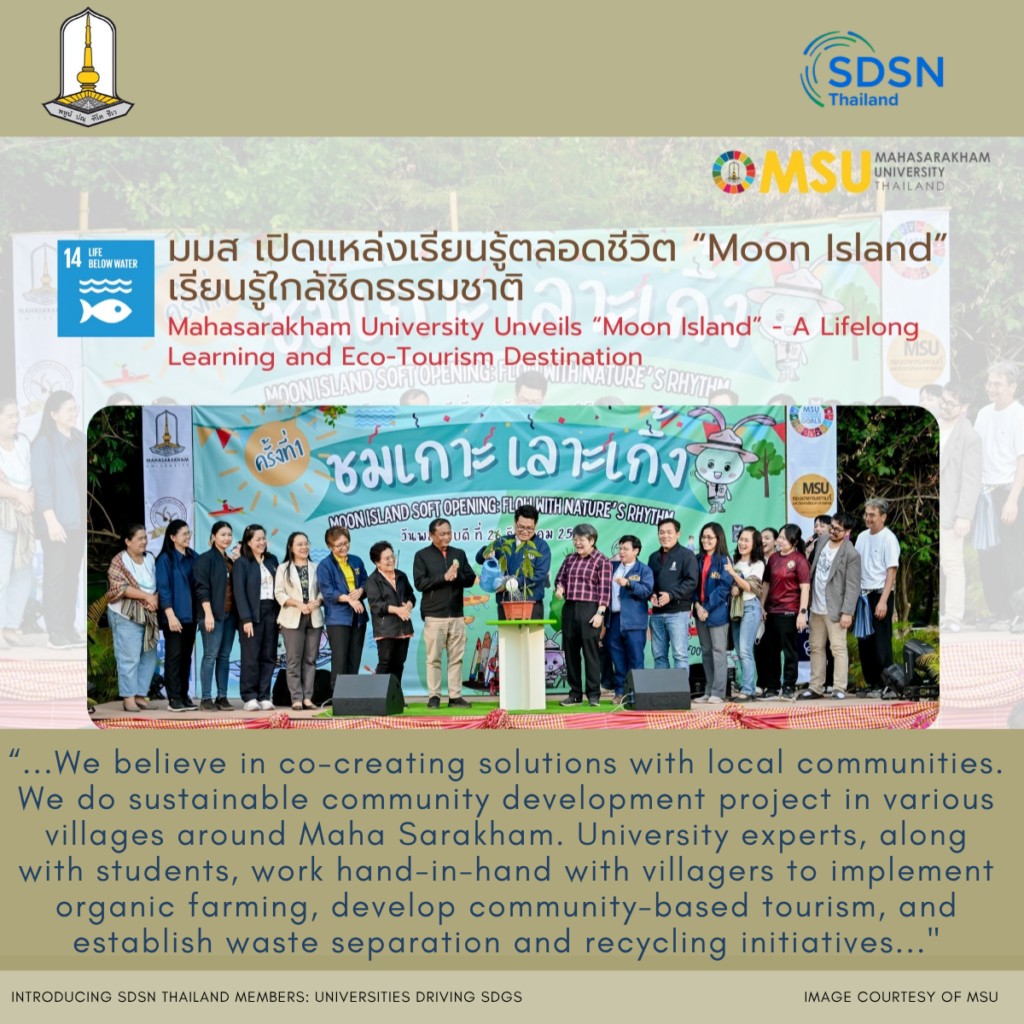
Dr. Sarinthree : One of our most innovative and community-integrated initiatives is the “Moon Island” Lifelong Learning Center Project, led by Walairukhavej Botanical Research Institute, in collaboration with the Faculty of Tourism and Hotel Management, the Faculty of Medicine, and other academic and administrative units.
Located in Ban Koeng Operation Station in Koeng Subdistrict, on the banks of the Chi River, the project transforms a natural riverside area into a living laboratory for sustainability, cultural heritage, and lifelong learning. Guided by the university’s policy and the development framework for 2023–2026, “Moon Island” promotes eco-tourism, organic agriculture, and environmental education, which making it a powerful example of applied research that aligns with SDG 14: Life Below Water, as well as SDG 4 (Quality Education), SDG 11 (Sustainable Cities and Communities), and SDG 12 (Responsible Consumption and Production).
The project is not only an academic field site, but also a recreational and educational destination. Activities such as eco-printing workshops, kayaking, stargazing, photography contests, local food markets, and classical folk music performances are all rooted in research-
What makes our projects truly impactful is their interdisciplinary nature and strong community collaboration. We believe that sustainability research must serve people. It not only by producing knowledge, but by building capacity, improving livelihoods, and restoring the environment.
SDSN Thailand : In your opinion, how effectively is Mahasarakham University aligned with the United Nations’ Sustainable Development Goals (SDGs) and can you provide examples of specific initiatives or projects that directly contribute to achieving these goals?
Dr. Sarinthree : MSU has integrated the Sustainable Development Goals (SDGs) into its university policies to address sustainability and use them as key performance indicators. This initiative aims to raise awareness and emphasize the importance of the SDGs among all faculties and departments within the university. Furthermore, these efforts directly contribute to MSU’s international university rankings. We have been working continuously on this, and this year, our university has achieved improved rankings in Times Higher Education (THE) World Impact Rankings for SDG 14 (Life Below Water), SDG 15 (Life on Land), and SDG 4 (Quality Education).
SDSN Thailand : How does Mahasarakham University engage with surrounding communities to promote sustainable practices and what are some of the successful cases?
Dr. Sarinthree : As the answer question no.3, the best practice project must be related to Moon Island, a Lifelong Learning Center, developed by Walairukhavej Botanical Research Institute in collaboration with multiple faculties in MSU. This initiative transforms a riverside area into a living laboratory for eco-tourism, organic agriculture, environmental education, and lifelong learning, supporting multiple SDGs, especially SDG 14 (Life Below Water), SDG 4 (Quality Education), and SDG 11 (Sustainable Cities and Communities). Activities include kayaking, eco-printing workshops, organic farming, stargazing, and local music—all designed with community participation. Early outcomes include increased income, reduced plastic waste, and enhanced environmental awareness. Moreover, MSU has a budget to run community projects. We believe in co-creating solutions with local communities. We do sustainable community development project in various villages around Maha Sarakham. University experts, along with students, work hand-in-hand with villagers to implement organic farming, develop community-based tourism, and establish waste separation and recycling initiatives. Another example is “One University One Tambon” project. Faculties adopt specific sub-districts to provide expertise and support for various sustainable development initiatives, leading to improved livelihoods and environmental management.
SDSN Thailand : How does international collaboration and global engagement contribute to enhancing sustainability education at Mahasarakham University?
Dr. Sarinthree : MSU collaborates with numerous international institutions to co-develop academic programs, research, and community engagement activities focused on sustainability. These partnerships support the internationalization of our curriculum, enhance faculty development, and provide students with meaningful global learning opportunities. Some notable examples include:
Joint Research and Education with Chinese Institutions
- Confucius Institute at MSU, in partnership with Guangxi Minzu University and Chongqing University of Posts and Telecommunications (CQUPT), supports cultural exchange and co-organizes events related to SDG 4 (Quality Education) and SDG 17 (Partnerships).
- MSU and CQUPT co-offer a Joint Bachelor’s Degree Program in Computer Science and Technology, integrating SDG content in ICT fields and promoting cross-cultural student learning.
EU-Funded Collaboration on Renewable Energy and Green Technology
- Through the Erasmus+ project, MSU co-established the Electric Vehicle and Energy Technology (MSU-EVETech) unit with partner institutions in Germany, Portugal, Greece, and Romania. This collaboration enhances local capacity in green energy, battery systems, and electric mobility, contributing directly to SDG 7 (Affordable and Clean Energy) and SDG 9 (Industry, Innovation, and Infrastructure).
Moreover, MSU actively participates in international networks and assessment frameworks to enhance the quality of education across multiple dimensions, particularly in sustainability. Key initiatives include:
– ASEAN University Network – Health Promotion Network (AUN-HPN) MSU is a member of the AUN-HPN, joining universities from Malaysia, Indonesia, the Philippines, and other ASEAN countries to exchange knowledge and develop best practices in promoting health and well-being among students and staff in higher education institutions. This collaboration aligns with SDG 3: Good Health and Well-being.
– Participation in Global Rankings and Assessment Systems: U-Multirank and THE Impact Rankings
Participation in these platforms enables Mahasarakham University to benchmark its performance against global standards, adopt best practices from leading institutions worldwide, and strengthen its role as a regional and global leader in sustainable development.

SDSN Thailand : What are the key challenges and opportunities for you to work on sustainability projects and perhaps promote them among international community you have been engaged with?
Dr. Sarinthree : At Mahasarakham University, our work on sustainability is grounded in strong community engagement, interdisciplinary research, and a clear institutional commitment to the SDGs. However, key challenges remain particularly limited resources, fragmented coordination across departments, and underrepresentation on global platforms. Our projects are often deeply rooted in local wisdom and rural contexts, which can make it difficult to align with international metrics or attract external funding.
Despite these challenges, MSU has unique opportunities to lead in sustainable development. Our strong trust-based partnerships with local communities, active participation in international networks such as SDSN, AUN-HPN, and Erasmus+, and success in global rankings like THE Impact Rankings position us to expand our impact. By leveraging digital communication tools, empowering students and young researchers, and strengthening cross-border collaborations, MSU can transform its locally driven innovations like the Moon Island Lifelong Learning Center into internationally recognized models for inclusive and sustainable development.


