
Interdisciplinary collaboration to tackle sustainability challenges
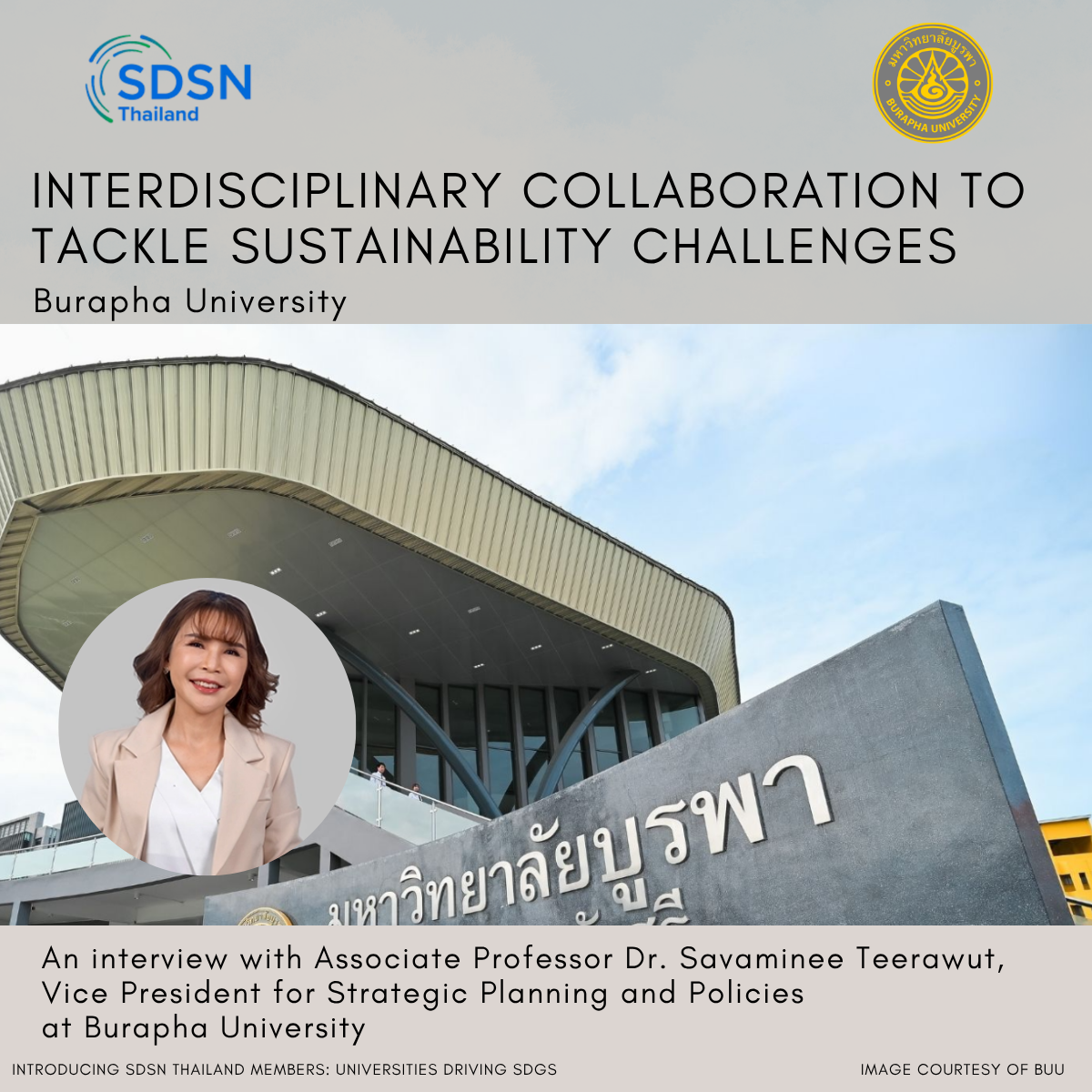
Continuing on SDSN Thailand member institutions introduction, we are pleased to introduce another distinguished member of the SDSN Thailand, Burapha University. The university is a leading institution in Thailand’s eastern region that has positioned itself as a driving force for sustainable development across multiple dimensions. The university’s distinctive strength lies in its collaborative “heart-shaped crucible” approach uniting knowledge, innovation, and the needs of local communities, government, and industry partners into a shared vision for sustainability. In this article, we invite you to get to know Burapha University through an exclusive interview with Asst. Prof. Savaminee Teerawut, Ph.D. — Vice President for Strategic Planning and Policies, a representative of the university’s leadership.
SDSN Thailand: What is your role in driving Burapha University to become a leader of sustainable development in Thailand?
Assoc.Prof.Dr. Savaminee : Actually, at Burapha University, we believe that everyone is a part of a sustainable society. Therefore, we see our role as being a place that serves as a crucible—a space that brings together knowledge, innovation, local needs, and the needs of society. We aim to be a place where all these elements are fused together to create an impact on society. We are confident that for society to be truly sustainable, it must share a common heart. That’s why we see ourselves as a heart-shaped crucible that unites these things into one heart. If people in this world still have different hearts, these goals cannot be achieved. So, that is how we view our role.
Especially in the eastern region, Burapha University has a vision to be the “wisdom hub of the East.” This crucible, therefore, is a place where knowledge, innovation, our quality personnel, and various partners—whether from the public sector, private sector, social sector, or local communities—come together to work towards sustainability. We aim to expand these results at the national or even international level.
We have never seen ourselves as having to be a leader, but rather as a catalyst in this heart-shaped crucible—encouraging everyone to recognize the importance of having one united heart. Once that heart beats as one, the hands that must take action will know what to do. This is the role that Burapha University sees for itself as a leader in sustainable development. This is our approach.
SDSN Thailand: What strategies do you believe are essential for integrating sustainability into the university’s core mission and operations?
Assoc.Prof.Dr. Savaminee : Regarding sustainability, we see that sustainability is not just a mission or a task. We believe that true sustainability should become a way of life—it should be integrated into our daily lives. That’s why we have adopted this concept of sustainability and incorporated it into the university’s strategic plan, making it a way of life and a way of thinking for everyone at the university.
We have included this in our strategic plan for the years 2025 to 2028, using what we call the Sustainable Social Development Platform as the main mechanism to drive sustainability. This platform starts from communicating the concept and building understanding, setting policies, implementing them, designing tools and support systems, and stimulating action through various activities and measures. The goal is to ensure that sustainability reaches every part of our organization, at all levels.
However, our ultimate goal is to embed sustainability into the way of life of everyone at Burapha. This is deployed as operational plans and knowledge-sharing throughout the organization, from the policy level down to the operational and evaluation levels. Even though these are university strategies, we don’t just work within our own system—we also collaborate with partners. We don’t see ourselves as simply givers or receivers, but as true partners. We work with a variety of partners, whether they are from society, the community, government, the private sector, or industry.
Our aim is not just to instill sustainability as a way of life for ourselves, but to extend it to everyone, including our partners and people in our area. It’s about bringing sustainability into daily life, but doing so strategically. It’s not just about suddenly telling everyone to be sustainable; we approach it strategically, with clear objectives. We know what needs to be done, when, and with whom.
SDSN Thailand: How does Burapha University foster interdisciplinary collaboration to tackle complex sustainability challenges, and what role do partnerships with government, civil society, and international organizations play in this?
Assoc.Prof.Dr. Savaminee : Now, regarding how we proceed, since we have established this as a major strategy, the basic missions of all universities are quite similar—providing education, producing research and innovation, and offering academic services. Every university does these things. But what we do differently is that we first set the main focus areas. Everything has phases of implementation.
In fact, when we look at sustainability, including all 17 Sustainable Development Goals (SDGs), we consider them all. However, given our capacity and focus, we cannot work on all goals simultaneously. Therefore, we have phased our approach. In the first phase, we ask ourselves: What does society need, especially in the eastern region? Where do we have the capacity to be a flagship? So, in the first three years, we focus on SDG 1 (No Poverty), SDG 3 (Good Health and Well-being), SDG 5 (Gender Equality), and SDG 14 (Life Below Water). We start with these flagship goals.
Once we begin, we look at those four or five SDG dimensions and ask: What does society truly need? What ultimate goals are they aiming for? Then we design accordingly. For example, if society lacks certain knowledge, what can we transfer? What kind of learning centers can we create? What knowledge can we provide?
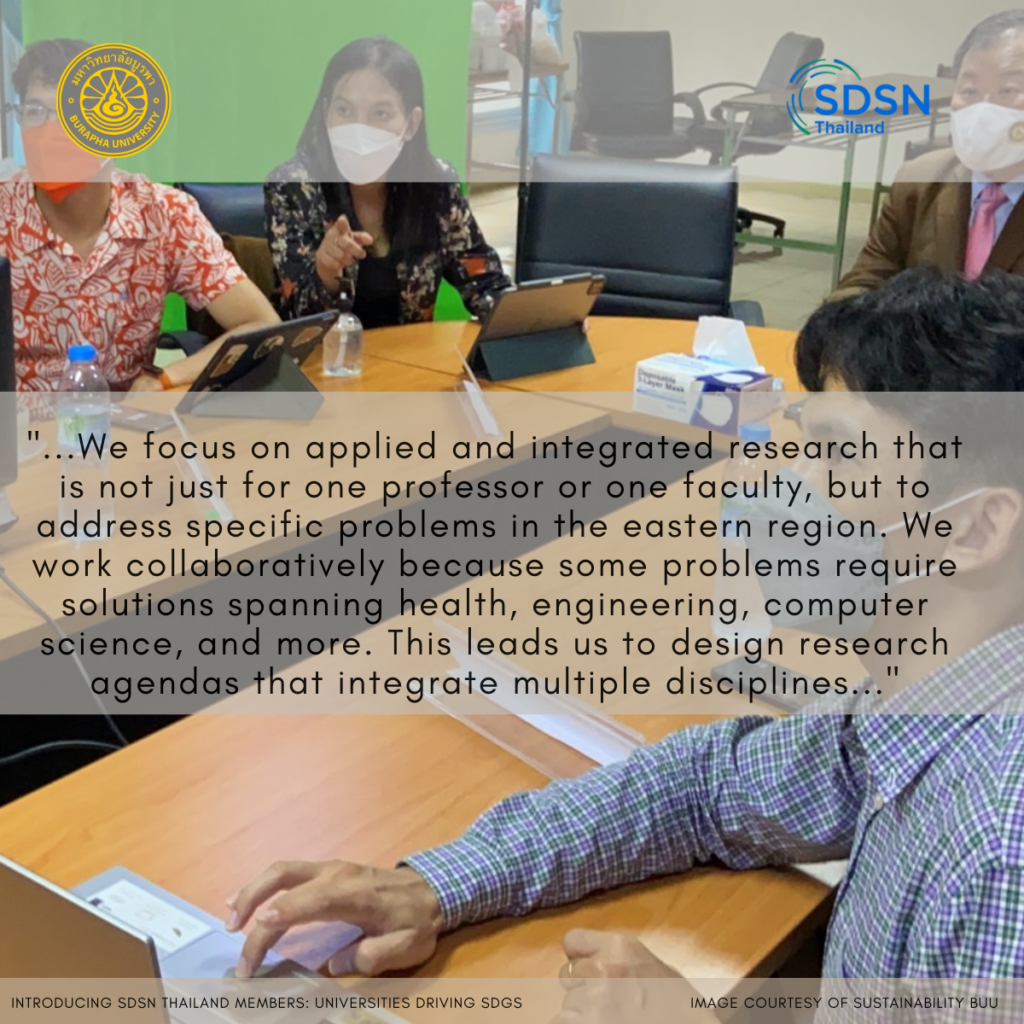
If society lacks research and innovation to solve problems, then the university sets research agendas accordingly. So, when defining research topics, we focus on applied and integrated research that is not just for one professor or one faculty, but to address specific problems in the eastern region. We work collaboratively because some problems require solutions spanning health, engineering, computer science, and more. This leads us to design research agendas that integrate multiple disciplines.
During this process, we continuously engage with our partners to ensure the research has real impact—whether it’s innovation that builds economic society, sustainable community development, or technology for academic services. This is how the university operates. The key principle is that we look at the ultimate goal, analyze the chain of problems, and reflect on what needs to be done, when, by whom, and what support systems are necessary. This is a key function in establishing the university’s operational system.
When we deliver outcomes to the community, they provide feedback—whether the initial problem definition was correct, whether implementation was effective, or if adjustments are needed. This creates a mindset and way of life not only within the university but also outside it. That is our fundamental approach.
SDSN Thailand: What are some of the most impactful SDG-related projects or initiatives currently underway at Burapha University?
Assoc.Prof.Dr. Savaminee : If we focus on the five dimensions mentioned earlier in Thailand, specifically the SDGs we are focusing on for these three years:
For SDG 1, No Poverty: We conduct research projects and academic service projects to transfer technology to factories. We have an EEC center located within the university, so various factories needing know-how can come here. This also includes know-how that we implement with communities. For example, we have a learning center focused on coastal studies, whose members include all local coastal government organizations. They observed that if local fishermen continue to fish using traditional methods, their poverty (which is SDG 1) persists. So, how can we use technology to help? We initiated a blue crab bank project, which enhanced their knowledge, improved their quality of life, generated income, and promoted sustainable resource management. This is an example of poverty eradication.
For SDG 3, Good Health and Well-being: We recognized that one significant problem during the COVID-19 pandemic was the limited capacity of medical facilities and hospitals due to the high number of patients. So, how could the university’s knowledge help? We developed an online patient care platform. Many universities have such platforms, but ours is not just for the eastern region; it’s used nationwide by approximately 300,000 people. This platform was a collaborative effort involving our Faculty of Engineering, Faculty of Nursing, Faculty of Medicine, and Faculty of Public Health, among others. It’s also free to use, and we received a global award for it. This is how we address good health and well-being.
For Quality Education: We provide education. The university sees itself as a knowledge source where people can acquire knowledge throughout their lives. Therefore, there are courses related to sustainability that students can enroll in, as well as online access courses and training programs. This concerns knowledge accessibility. Access to this education is free, and people of all ages can benefit without charge. Every time we conduct training, we embed knowledge about sustainable development to educate people. We believe that if people understand, they will find ways within their own context to contribute. This is about quality education.
For SDG 9, Industry, Innovation, and Infrastructure: We are a university in the technology and innovation group, located in an area with high demand for technology and innovation, especially in the eastern region, which includes the EEC. Therefore, we aim to conduct research and create innovations that address both industrial and social needs. Why do we say industrial needs? Sometimes, people might think this is solely economic, but it’s not. Many of our innovations help factories reduce waste and pollution released into communities, save production time, and improve the management of communities around industrial areas. We also support startups, focusing on those that bring innovation to communities or create economic impact, because we believe that society, civil society, and industry all require innovation to drive progress. We have produced many innovations and serve as a business incubator for them.
For SDG 14, Life Below Water: Our strength at Burapha University lies in extensive marine animal research. We are leaders in marine resource conservation projects, including artificial coral reef research, the discovery of new extracts from underwater plants or organisms, marine pollution reduction, and sustainable coastal resource management—ensuring aquatic life can continue to thrive. These are our key projects. These are examples of the five SDGs we prioritize.
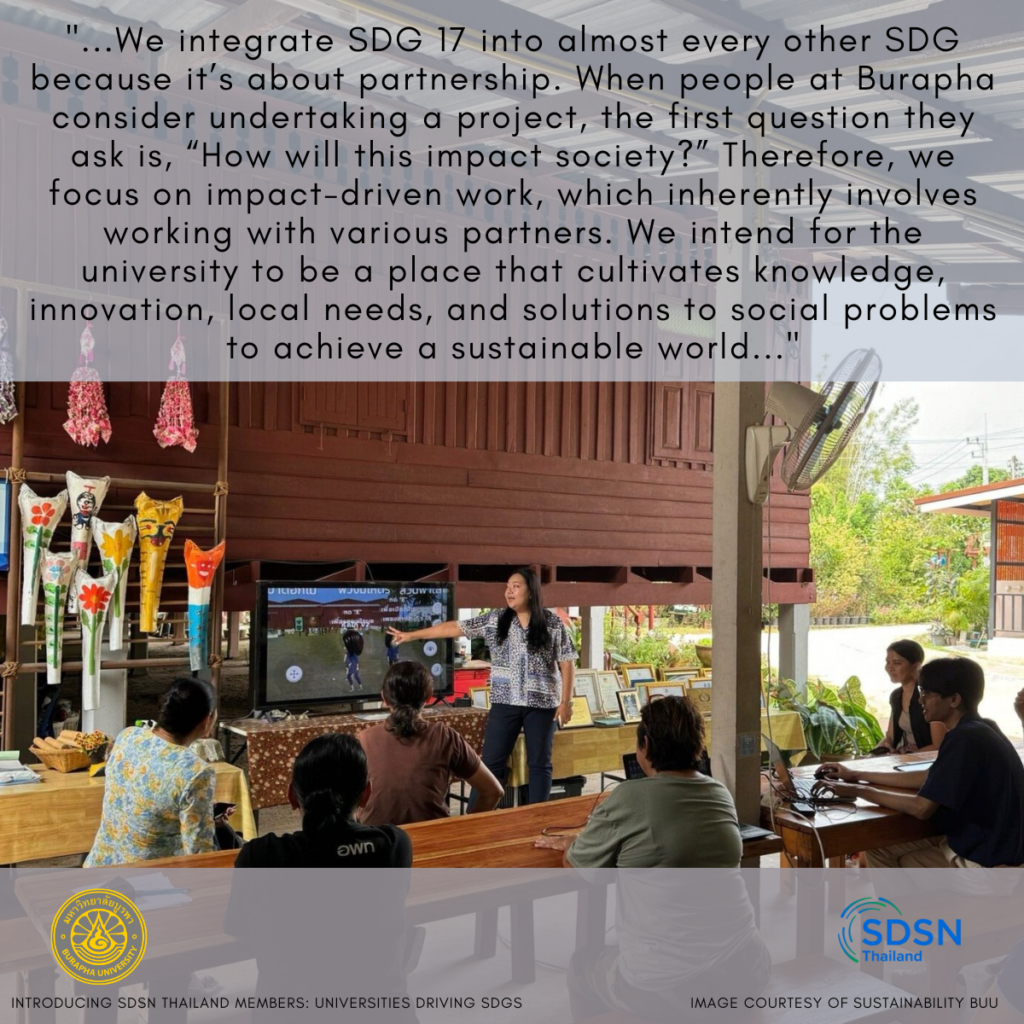
Regarding SDG 17, Partnerships for the Goals: We integrate SDG 17 into almost every other SDG because it’s about partnership. When people at Burapha consider undertaking a project, the first question they ask is, “How will this impact society?” I believe this thought is ingrained in their minds. Second, they consider who they can collaborate with to achieve that impact. Therefore, we focus on impact-driven work, which inherently involves working with various partners. This is the overall picture: we intend for the university to be a place that cultivates knowledge, innovation, local needs, and solutions to social problems to achieve a sustainable world.
SDSN Thailand : How does Burapha University engage with surrounding communities to promote sustainable practices and what are some of the successful cases?
Assoc.Prof.Dr. Savaminee : The way we work with partners is by first asking what the communities in the eastern region need. We start with policy-level partners. For example, we work with SDG Move, where we seek to identify needs and set regional indicators. This is one example of a policy partner. When asked how we came to know SDG Move, we explained that the university has such a commitment, so we looked for and connected with SDG Move, which was already working on this. We then asked how we could partner with them, leading us to collaborate on developing appropriate indicators. This is a main example of our policy-level partnership work.
Regarding operational partners, since Burapha University is located in the eastern region, we have several specialized centers. For example, the Integrated Coastal Learning Network Center works with the Department of Marine and Coastal Resources. This project is also international in scope, and we serve as a primary center. After that, we seek partners among local administrative organizations who are key players. We discuss our intentions—what sustainability dimensions we want to build and the problems they face. We create spaces for dialogue. When we talk, we identify problem areas we might not be able to solve alone, so we seek new partners to help. If we can solve the problems, we go directly to assist the community.
However, our approach at Burapha is not to just impose solutions. We ask the community to participate in solving problems to foster ownership. We gradually engage the community and partners in the process so they feel a sense of ownership and envision the future they want for their area. This approach ensures our work has real impact and gains cooperation.
This is how we work with partners: finding partners to collaborate with, building mutual understanding, involving them in action, following up, and supporting each other. If current partners are insufficient, we encourage them to find more partners. We have no limitations on partners. One issue often expands into many others.
For example, with PEMSEA and the Integrated Coastal Centers, the university’s center, the Integrated Coastal Learning and Network Center, works with the Department of Marine and Coastal Resources, a national organization. Our center then finds partners among local administrative organizations. We view integrated coastal management as a major global issue, so we partner with PEMSEA, an international partner affiliated with ASEAN and global networks. This creates collaboration among local, national, and global partners. This is the overall approach we take in working with partners.
SDSN Thailand : In your view, what are the key challenges and opportunities in the work of sustainability?
Assoc.Prof.Dr. Savaminee : The key challenge to making all hearts beat in unison is communication. Everyone thinks their own way, and others think differently, but if we don’t communicate how we tune our thoughts together—whether our ultimate goals align as one heart—that becomes a problem. Therefore, the main communication challenge is that we must shift our mindset toward communication and taking action. This, I believe, is the key to success that will make what we do concrete and truly sustainable.
Communication must include everyone within our organization, our partners, and the communities. It means aligning the rhythm of our hearts—we need to check that we are beating to the same rhythm. If we share the same rhythm, eventually we will become one heart. But if our heartbeats are out of sync, it will be unstable. So, how do we tune our heartbeats together? It requires conversation—talking about who plays important roles in what areas, where they can help, what roles we have, and where we can assist each other. We need to understand where we stand in the shared goal and how we can support one another.
SDSN Thailand : Looking ahead, how is Burapha University planning to enhance its impact on Thailand’s sustainable development agenda, and what innovations or new directions do you foresee for the university’s SDG efforts?
Assoc.Prof.Dr. Savaminee : Actually, looking forward, I think that whether it is today or in the future, the most important thing is that we should not just focus on what we can do or what we do first and keep it to ourselves. Instead, we must look ahead and think long-term. We should not only consider what the world and the country need today, but also forecast and have foresight about what the world will need 10 years from now, 20 years from now. We must take both current and future needs and work backward to understand what knowledge and skills are required.
The key point is that we must be able to foresee how the world’s sustainability needs will evolve in 2 years, 5 years, 10 years, and 20 years. Once we have that foresight, we bring it back to the present. We will then know what problems will still need solving in 5 years and what gaps exist. We conduct a gap analysis. After that, we identify what the university can contribute. Of course, the university cannot fill all the gaps because sustainability is not just the university’s responsibility—it involves everyone on the planet.
Therefore, the university looks at how its partners can fill those gaps, whether by finding new partners, collaborating with others, or even working with other universities. Once we share the same vision, we communicate to align our heartbeats—deciding who should do what and when. Ultimately, we will have the same “song” and gradually play it together. This will address sustainability not only for today but also for the future.
Some outcomes happen today, but some require preparation now to achieve sustainable results later. So, sustainability is not just about focusing on today; it’s about looking to the future and understanding what a sustainable world needs. This way, all hearts can beat in the same rhythm, knowing exactly which issues to focus on and when to act.


