
SDSN Thailand Public Forum 2025: Charting the Final Stretch to 2030 : 10 Years of the SDGs — Reflect, Realign, and Move Forward
18–19 November 2025, Ministry of Foreign Affairs, Bangkok
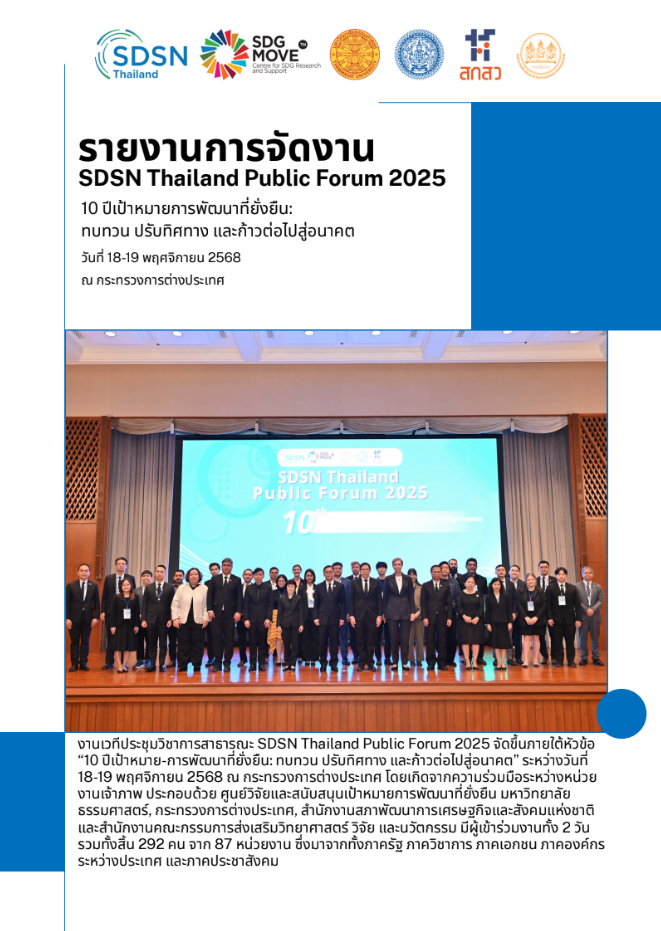
The Sustainable Development Solutions Network Thailand (SDSN Thailand), together with SDG Move (Thammasat University), the Ministry of Foreign Affairs, the Office of the National Economic and Social Development Council, and the National Research Council of Thailand, convened the SDSN Thailand Public Forum 2025 — a two-day academic forum bringing together 292 participants from 87 organizations across government, academia, the private sector, international bodies, and civil society.
Held at the symbolic midpoint of the final five-year push toward the 2030 Agenda, the Forum served as a platform to review a decade of progress on the Sustainable Development Goals (SDGs), confront Thailand’s structural challenges, and co-develop actionable mechanisms to accelerate the country’s sustainability transition.
Key Takeaways
1. Thailand ranks well regionally — but structural risks are deepening.
Thailand holds 43rd place globally and 1st in ASEAN on the SDG Index, yet core challenges — inequality, education and digital-skills gaps, non-communicable disease burden, air pollution, and eroding state capability — show signs of stagnation or regression rather than progress.
2. The next five years demand system transformation, not more pilot projects.
Participants agreed Thailand must shift from a “project-based” to a “systems-based” approach — an economy-wide realignment of incentives, institutions, and infrastructure rather than isolated interventions.
3. Six acceleration mechanisms were identified as national priorities:
- A National SDG Data Ecosystem, powered by AI and open data
- A Science–Policy–Society Interface to close the evidence-to-policy gap
- An Integrated National Financing Framework (INFF) to close Thailand’s sustainability financing gap
- SDG Localization, empowering provinces and cities to lead place-based innovation
- Universities repositioned as “SDG Accelerators” — knowledge hubs bridging science, policy, and community
- Sustained multi-stakeholder collaboration, including ASEAN-level cooperation on climate and biodiversity
4. Universities are reframed as strategic intermediaries, not just knowledge producers.
The Forum called on higher education institutions to move beyond producing graduates and research, toward actively translating evidence into policy, piloting local innovation, and building future-ready skills.
5. Building “Common Trust” is the foundation for lasting cooperation.
In a shifting multipolar world, the Forum emphasized that sustainable development partnerships must be grounded not only in shared economic interest, but in transparency, equitable participation, and mutual respect across sectors.
👉 Read the full SDSN Thailand Public Forum 2025 Report (Thai Version)


